

Every day, hundreds of children in Ukraine face cyberbullying on anonymous Telegram channels that are gaining popularity among teenagers. These communities not only publish offensive and violent content, but also make money from public harassment, demanding payments for removing posts and revealing the authors of offensive content. The channel administrators often remain in the shadows, and when the police manage to identify them, it turns out that behind the nicknames on Telegram are often children, for whose actions the courts punish their parents.
The Suspilne investigative editorial office has found out how such anonymous communities gain popularity among teenagers in Ukrainian cities and why combating cyberbullying remains a complex problem.
"I felt very uncomfortable. I do not know who could do it"
In January 2025, Ivanna, a school tenth-grader, received a message from a friend with a link to a Telegram channel where someone had published a post with her photo.
"I had never visited this Telegram channel and I did not know about it. I opened the link and there were very, very bad words written there: that I was a village girl, I did not go to the gym, I was a girl of easy virtue, and other insults," Ivanna recalls.
The post about Ivanna was placed on the anonymous Russian-language Telegram channel "Zerkalo (Mirror)", which is engaged in cyberbullying of teenagers mainly from Rivne region. This channel, like many similar ones, is not displayed in the Telegram search. It can only be found with a hyperlink. Despite this, in the two months of its existence, "Mirror" has gained more than 12 thousand subscribers, to whom it every day offers dozens of publications with bullying of children.
The channel administrators explain that the authors of these posts are people who "decided to express their opinion about their acquaintances". They say they are only publishing what was sent to them and do not bear any responsibility for what was said.

"I felt very uncomfortable. I do not know who could do it. I did not offend anyone. I wrote a comment to have the post deleted, "Please, delete all these photos and words". However, other comments said, "What are you speaking about?" Ivanna says.
Then the girl asked to remove the post about her by sending a message to a special bot that moderates the channel. The bot responded. It turned out that deleting an offensive post is a paid service, for which they want 200 hryvnias to be transferred to a bankcard.
For another 200 hryvnias, the administrators offered to reveal who the author of the bullying post was. The girl refused to pay, as she doubted that the post would be deleted. Then anonymous people started writing to her: one offered information about the author of the post, including the passport number, and the other threatened.
"You have not realized yet that you are in trouble", "the goal is to destroy you". These were the messages that Ivanna was receiving.
The author of the threats wrote to the girl that he had compromising information about her, for posting which he was paid, and he would publish it if she did not pay. Despite the threats, Ivanna refused to pay. Then several other offensive posts about the girl appeared on "Mirror", and later about her friend Emma, who faced bullying after she began to defend Ivanna in the comments.
"They wrote about me that I was a drug addict. It is just ridiculous, and about her (Ivanna — Ed.), they wrote such things that I am even ashamed to quote. They are trying to find some ways of anonymous bullying to insult a person. Although, in fact, neither my friend nor I did anything written there. There were people who discussed it at school, but in general, everyone supported us. Many of my friends suffered from posts in this group," says Emma.
Not only children but also adults become victims of cyberbullying on Telegram channels. In 2024, Iryna Moroz, a Math teacher from Zviahel, Zhytomyr region, faced this phenomenon on the Telegram channel "Essence of Zviahel".
"A friend of mine wrote to me and sent a Telegram link with a post about me. She said that the whole our medical college was buzzing, because there were students in the group. I was shocked. In the post, there was a photo taken six or seven years ago when I was photographed for the "Teacher of the Year" competition. They found this photo (the woman is holding a diploma in it — Ed.), and they added letter "Z" [symbol of Russian invasion of Ukraine] to it. They wrote that I supported and sponsored Russians, and called to "spit on me” if anyone sees me," says Iryna.
According to her, the post not only caused psychological trauma, but also provoked gossip among students, despite the fact that she actively supports the Armed Forces of Ukraine, her son is a volunteer, and her husband was defending the country at the front at that time.
The woman decided to defend her reputation and went to court, where she proved that the information about her was false. However, by that time, the channel had already been deleted, and it was not possible to identify the administrators and the author of the offensive post.
"It is a pity that it is impossible to hold moral criminals accountable," Iryna states.
How do they make money by cyberbullying?
As the investigative editorial office found out, the peak of activity of Telegram communities, in which teenagers are mainly bullied, fell on 2024, although such channels had existed before. Many of them had identical names, consisting of the Russian word "essence" and the name of the city: "Essence of Lviv", "Essence of Dnipro", etc.
In 2025, not only "essences", but also "mirrors" are trendy. However, in some cities such channels have other names.
On the one hand, the activities of Telegram communities with bullying content resemble a closed club, which can usually be entered after the channel moderator approves the request. On the other hand, anonymous administrators try to attract as many people as possible: they create chats for communication between participants and groups with limited and often paid access, hold raffles, the condition for participation in which is inviting friends to the channel, and organize online games. That is, they try in every possible way to attract a new loyal audience. In turn, those who disagree with the actions of the administrators or criticize the channel may be banned or become victims of bullying.
Community members also participate in all this, becoming authors of posts and commenters. Of course, most participants are rather passive observers. However, the fact that the activities of such Telegram channels are little known to the public may indicate that children rarely tell adults about them. Instead, teenagers willingly share their impressions on social networks.
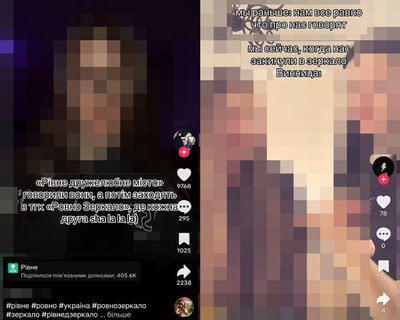
For example, there are dozens of TikTok trending videos in which teenagers talk about cyberbullying on Telegram. However, judging by the reactions to such videos, the public is more interested in the opportunity to join these Telegram channels than indignant about the fact of bullying itself.
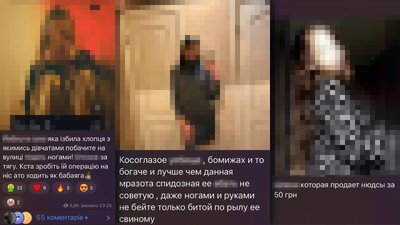
Criticism and ridicule of children’s appearance and behavior are inherent in every bullying post on Telegram channels. Often, the authors of anonymous posts try to hurt the victim by publishing details from their life, nuances about their family, or certain flaws.
Doing this, the authors use obscene language, insults, and lies about minors, accusing them, for example, of distributing intimate images or engaging in sexual activity. Such posts can have psychological consequences for the victims of bullying.
Telegram channels formally have rules that can be found in their descriptions. According to them, the responsibility for the content lies with its authors, that is, those who send offensive posts about their acquaintances. The rules also prohibit sending content of a sexual nature, disclosing personal data, or calling for any action.
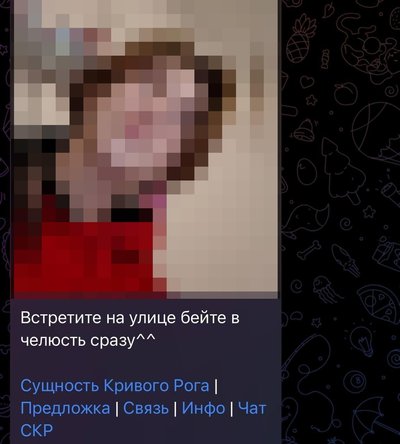
However, these rules are violated by both administrators and community members, as bullying posts are often accompanied by calls for violence, "if you see this person, kick them", "if you see this person, spit in their face", etc. At the same time, in the comments under the posts, discussions about the victims of bullying take place and their personal information is revealed.
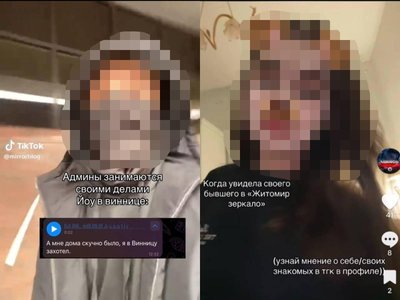
Often, the same administrators launch several cyberbullying channels in different cities. For example, this was the case with the "Mirror" network, which covered Vinnytsia, Zhytomyr, Rivne, Odesa, and later also the Russian cities of Kazan and Saratov. This network appeared in late 2024 and was blocked in February 2025.
Before the blocking, the network advertised itself on TikTok and Instagram, and encouraged its subscribers to do the same. On TikTok, for example, teenagers filmed similar videos with advertisements for "Mirror" set to Russian music. Administrators promised a reward of 100 hryvnias for one such video.
The prices for "services" on Telegram channels with bullying content vary. The Suspilne investigative journalist asked to remove offensive posts about teenagers from nine different communities. The prices ranged from 100 to 600 hryvnias, which had to be transferred to a bankcard. For "additional services", such as revealing the author of the post or "reservation", which is a guarantee that publications about you will not appear again, they demanded to pay more.
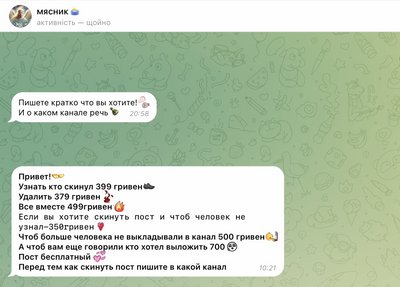
The cost of the "services" could vary depending on the type of post being requested to be removed. For example, the mother of a child, who was bullied on the Telegram channel "Zhytomyr Mirror", said on Facebook that she was asked to pay 600 hryvnias to remove a post about her child.
When we contacted two channels of this network with a request to remove the post, they asked to pay 100 hryvnias, and they could reveal the author of the post for 300 hryvnias.
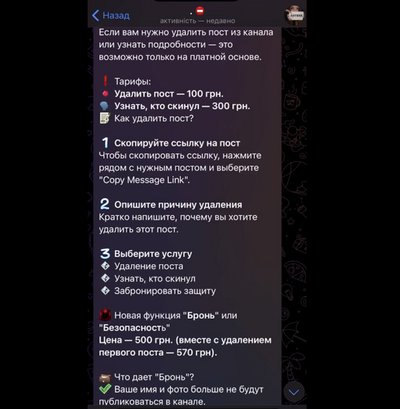
Telegram channels with bullying content also earn money by placing advertisements, for example, of vape shops, or use dubious sources of income. Another source of income is the requirement of a "deposit" from those who wish to become channel administrators.
For example, on the Telegram channel "Chronicles of the Fourth" (Volyn region), which had almost 26 thousand subscribers, those who wanted to become administrators were asked to pay 1,500-2,500 hryvnias via bankcard, promising up to six thousand hryvnias of earnings per week.
The Suspilne investigative journalist spoke with the channel administrator, who called herself Valeria and explained that the administrator’s responsibilities include publishing 20 bullying posts per day, conducting voice broadcasts with subscribers, and moderating chats.
According to Valeria, a new employee receives a mobile phone number and access to the administration, and the deposit is returned upon resigning. Valeria and other administrators of similar communities used pressure during communication, demanding an immediate transfer of funds, which is a sign of fraud.
Recently, the "Chronicles of the Fourth" channel was blocked, but the administrators were prepared for this and launched another one. Now they demand payment for “services” in cryptocurrency.
Who is responsible for cyberbullying?
The police are trying to block communities with cyberbullying content using the volunteer project "Cyber Gate" or apply to the Telegram administration with requests to block such channels. Thus, as a rule, such channels do not exist for long.
In Cherkasy alone, in 2023-2024, the police revealed and managed to block 15 communities. We learned about this from the response to our request of the Main Directorate of the National Police in Cherkasy region.
However, the channels are prepared for this, as administrators create backup channels in advance and launch them immediately after blocking the previous ones. Links to backup channels can often be seen in active channels.
It is difficult to stop this flow, as the organizers mask their activities: they use virtual or "clean" phone numbers registered in different countries to create anonymous Telegram accounts, do not reveal their personal data, and often use crypto wallets, which makes them practically undetectable.
A clue that could lead to the organizers is the bankcard number to which the funds are transferred. The Suspilne investigative journalist figured out the numbers of six cards of different banks used by the administrators of cyberbullying communities.
The banks servicing these accounts, citing banking secrecy, did not disclose the personal details of the recipients. However, in one case, we were able to identify the cardholder — the name was voiced at the bank counter.
The bank account of 18-year-old Yaroslav from Vinnytsia received funds from those who wanted to remove bullying posts from the channels of the "Mirror" network, which until recently operated in Vinnytsia, Zhytomyr, Rivne, and Odesa.
Yaroslav indicates on the Russian social media that the most important thing for him is his career and money. However, we were unable to talk by phone about his earnings from Telegram channels, as all Yaroslav’s and his mother’s mobile numbers turned out to be invalid.
We contacted Yaroslav on Facebook with questions about his involvement in the "Mirror" Telegram channels. We have not received a response yet.
In addition, we managed to identify one of the "Mirror" network administrators, who also promoted channels on TikTok. She is Alina, a 16-year-old school student from Vinnytsia, who also posted videos on her social media, saying that she likes to bully her peers.
Since Alina did not respond to our calls on Telegram, we sent her and her father a message asking them to comment on the girl’s participation in cyberbullying communities. We have not received any response.
We will pass the collected materials about Yaroslav and Alina to the law enforcement.
How is cyberbullying punished?
The Ukrainian legislation provides administrative punishment for bullying (including using electronic communications, i.e. cyberbullying) as a fine or community service. However, for bullying committed by minors under the age of 16, their parents are responsible.
Suspilne sent information requests to almost all main departments of the National Police of Ukraine, except for the Main Police Department in Crimea, about the activities of Telegram channels related to cyberbullying.
It turned out that hundreds of people, including parents of children who were victims of cyberbullying, had filed statements to the police complaining about the activities of such Telegram channels.
Our analysis of responses to the information requests showed that in 2023, the police received 37 reports regarding the activities of such Telegram channels. In 2024, the number of reports increased to 291. In 2025, this trend continues: the police reported receiving at least 75 complaints in the first two months of the year.
In addition, the Main Departments of National Police of Kyiv, Ivano-Frankivsk, and Poltava regions reported receiving a total of 40 applications for 2023-2025, but did not specify the number of applications per year.
The claimants complained about violations of children’s rights, disclosure of personal information, lies, publication of pornographic photos and videos, extortion, violence, promotion of hatred, etc.
There were even more serious accusations. Thus, in response to our request, the Kherson District Police Department reported that in February it received a complaint about the Telegram channel "Essence of Kherson", which "publishes photos of underage children, leads to suicidal actions, and violates children’s rights. In some posts, the administrator writes about drug use, writes about the price".
However, numerous complaints rarely lead to investigations, as the police often do not see the actions of Telegram channels as constituting a criminal offense. This is evidenced by statistics for 2023-2024, during which the police received at least 368 complaints, but opened only 13 criminal proceedings, some of which were later closed.
In addition, let us remind that according to the Ukrainian legislation, cyberbullying is not a criminal offense, but only an administrative one.
In cases when criminal proceedings were launched, the police investigated various crimes, including extortion, fraud, threats of murder, unauthorized actions with information, gaining access to child pornography, importing, producing, or distributing works that promote the cult of violence and cruelty, as well as racial, national, or religious intolerance and discrimination.
Most often, the police qualified the actions of the criminals as a violation of privacy. This crime is punishable by a fine, restriction of liberty, or even imprisonment for 3-5 years.
In the court register, we found seven criminal cases against Telegram channels specializing in cyberbullying. The trials are ongoing and none of them has yet resulted in a verdict. Via court decisions, law enforcement officers identify the owners of bankcards that received funds for the channels’ "services", conduct searches at the residences of those involved, and confiscate phones, cards, and other property that is likely to be involved in the crimes.
It is interesting that in some cases, when the police managed to track down those involved in the activities of Telegram communities, it turned out that children were responsible for this.
The Ukrainian legislation provides for criminal liability for adolescents aged 14 and over only for certain serious and especially serious crimes, including extortion.
In parallel with criminal investigations, the police draw up administrative offense reports for evading parental duties against parents of Telegram channel administrators who are under 16 years old. The courts find them guilty of improper upbringing of children and punish them with fines of 850 hryvnias. The parents are also forced to pay a court fee of 650 hryvnias.
In addition, courts also hold accountable parents of children who were the authors of at least one offensive post about a classmate, teacher, or the parents of their acquaintances.
For example, in Kropyvnytskyi, the court decided that the mother of a minor did not fulfill her parental duties, because her minor son posted a photo with humiliating comments about a classmate and his mother on the Telegram channel "Shame of Ukraine".
Police officers also draw up administrative reports against parents whose children were the authors of photos that later were posted on Telegram channels. This happened in the case of the mother of a Cherkasy school student who took a photo of a classmate in the restroom. Later, this photo appeared on the Telegram channel "Essence of Cherkasy". The mother managed to prove her son’s innocence in the publication on Telegram, due to which she avoided punishment.
Tetiana Kharkivska, a social affairs manager at the public organization "La Strada — Ukraine" and consultant to the National Hotline for Children and Youth, notes that holding parents accountable for cyberbullying committed by their young children has both advantages and challenges.
On the one hand, the legal practice sees the imposition of a fine as a mechanism to encourage parents to be more responsible for the digital environment of their children, as well as to control the content they consume and the platforms on which they interact. On the other hand, not all parents can control their children’s online activity.
"During adolescence, children gain significant autonomy in the online space, often hiding their digital activity. Due to their higher level of digital literacy, they are often ahead of their parents, which makes it difficult to control their behavior on social networks. In such a situation, it is important to conduct preventive educational activities. At the same time, one of the effective approaches can be to increase the emphasis on the personal responsibility of children themselves," says Tetiana Kharkivska.
How cyberbullying affects children
According to a UNICEF study, one in five teenagers in Ukraine experienced online bullying in 2023. Tetiana Kharkivska notes that cyberbullying became widespread in Ukraine during the COVID-19 pandemic and intensified after the beginning of the full-scale Russian invasion.
In particular, this is due to the fact that children’s education and communication moved online. According to Tetiana, in 2024 the National Hotline for Children and Youth received 168 thousand calls, of which 4% concerned children’s safety requests on the Internet.

"Cyberbullying has a serious impact on the psycho-emotional condition of a child, which can be reflected in both psychological and physical health. According to observations, victims often face reduced self-esteem, increased levels of anxiety, and depressive states. Such negative factors can lead to suicidal thoughts and a tendency to self-harm, which requires timely intervention and comprehensive support," says Tetiana Kharkivska.
Among the key factors that motivate teenagers to create offensive or violent content, the expert highlights the desire for self-affirmation, entertainment, as well as the impact of influencers, whose behavior shapes and legitimizes such models of interaction.
"There is a trend in which children who are themselves victims of domestic violence are more likely to engage in cyberbullying. In this way, they can compensate for their own experience of vulnerability by trying to assert themselves in the social environment through aggressive behavior," explains Tetiana Kharkivska.
The expert notes that in many cases, children are not aware of the real consequences of their actions. This stresses the need for educational work with them to develop critical thinking. NGOs and law enforcement agencies are already working with schools in this direction.
In particular, the NGO "La Strada — Ukraine" has developed educational programs that have already received official approval from the Ministry of Education and Science of Ukraine for use in educational institutions. Among them, for example, there are manuals on dangerous quests for children, on a systematic approach to combating bullying, and a manual on basic peer mediation skills.
"It is important to develop critical thinking in children and young people, in particular in terms of analyzing and recognizing fake information and disinformation. One of the reasons why teenagers underestimate the consequences of cyberbullying is insufficient awareness of its real consequences and possible risks, as well as the lack of public attention to such situations. It is important that children understand responsibility for their actions in the digital environment and the potential impact of even thoughtless jokes," Tetiana Kharkivska notes.
The expert advises teenagers who are experiencing cyberbullying or other types of online violence to seek advice and support by calling the National Hotline for Children and Youth. The line operates 24 hours a day, free of charge and anonymously at phone number 116 11.
The Cyber Police of Ukraine, which records such cases and blocks Telegram channels, also explains in detail how to respond to cyberbullying and protect oneself from this phenomenon.