
As soon as the administration of US President Donald Trump suspended military aid to Ukraine, which was approved under Joe Biden, National Security Advisor Jake Sullivan published an op-ed in The New York Times sharply criticizing the decision.
Critics point out that it was Sullivan who once delayed the delivery of weapons to Kyiv and encouraged the White House to limit the use of long-range weapons. Now he denies these accusations, assuring that the Biden administration was simply acting within the available resources, taking into account the risks to the global economy and the threat of direct escalation with Russia.
Suspilne spoke with Jake Sullivan about the Trump administration's approach to ending the Russian-Ukrainian war, the best means of putting pressure on Russia, and why the White House under Biden was so cautious about supplying weapons to Ukraine and whether it was justified.
The conversation took place before Donald Trump's announcement on the night of July 8 that he would increase aid to Ukraine.
It's been a week since the Trump Administration withheld military aid to Ukraine that had already been approved by the Biden administration. You recently wrote an op-ed for the New York Times criticizing this decision, calling it an “abandonment of Ukraine”. To what extent do you think the Trump administration is constrained by Trump's own “no more stupid wars” rhetoric? Do you think that the withheld, or withdrawal or suspension of military support to Ukraine harms the long-term national security interest of the United States in any capacity?
Well, I certainly believe that withholding this needed and deserved weaponry, especially the air defenses, but all of the other military assistance as well harms not only Ukraine in its fight for freedom against the Russian aggressor, it also hurts the United States because it undermines our credibility, and it emboldens and empowers Russia, who is not just an adversary of Ukraine, but is an adversary of the United States of America and NATO as well.
So, from my perspective, the right thing to do would be to release all of that equipment. And, in fact, as I said in the op-ed, to send additional shipments and approve more shipments beyond what we approved during the Biden’s Administration, which has still been flowing into Ukraine over the last several months.
And furthermore, I think if the Trump’s administration is not prepared to pay for that equipment, many European countries are prepared to do so, and so the Trump administration should make a deal with European countries: they provide the money, and the United States provides the arms.
What do you think cannot be replaced in terms of American support? Trump administration keeps saying that Europeans need to step in, but many American systems have no analogues.
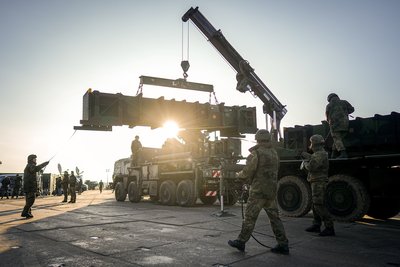
Well, I started by mentioning the air defense, the Patriot interceptors, and also another form of interceptor called AMRAAM, which goes in the NASAMS missile defense system, which itself has been very effective in addition to the Patriots. Both of them have to be approved by the United States. Now, as I said, they could be funded by the Europeans. But it's harder for the Europeans to actually supply them, because it's an American system, and we're the ones consistently producing it, and therefore in a position to supply it to Ukraine.
One of the things we did during Biden's administration is we took all of the Patriot missiles and all of the AMRAAM that were going to be shipped to every country that we sell to around the world and we said: “Ukraine is first in line. They are going to get them before anyone else gets them. And they are going to basically get all of them because they're the ones who are actually under missile attack from these brutal Russian missiles coming down on Ukrainian cities and killing civilians.”
So it's that kind of thing that the United States has to supply. There are other systems, too, like the ammunition for HIMARS or Hellfire missiles, or other things that have been very valuable to the Ukrainians that only the United States can really supply. And it's critical that the US step up and do its part to supply those things which no other country has.
What is your assessment of the current situation in the Middle East? How the recent US strikes on Iran affected the strategic alignment between Iran, North Korea, Russia, and China. And to what extent do these developments expose the US to the risk of war with Iran and potentially with the emerging CRINK coalition?
Well, first one thing to point out is that Iran has been supporting Russia in its war against Ukraine, but Russia did not step up and support Iran when Iran came under attack by Israel and the United States. So it's been, I think, a quite brutal lesson for the Iranians that you can't count on Russia to be a friend to you after you've been a friend to it, and I think that that will have an impact on Iran calculus going forward.
I think China is also seeing that. The North Koreans are different. They are doubling and tripling down on their support for Russia and I think that that is likely to continue.
In terms of the United States, right now there is a ceasefire in place, so there is no active hostilities between the United States and Iran, or between Israel and Iran. That, of course, could change in the future.
That risk is higher today than it was, say, a couple of months ago. But my hope is that what will happen instead is that the Trump’s administration pursues a diplomatic deal to get the nuclear program of Iran (elements of which still exist) fully limited so that Iran can never get a nuclear weapon.
And I believe that there is no reason the United States cannot protect our troops in the Middle East, defend our interests and partners there, and supply Ukraine with weaponry and military assistance. We can do both. We should do both.
Fair enough. What about China? What about the Chinese threat that Trump’s administration keeps talking about and the Readiness report that is specifically mentioning the Indo-Pacific threat?
I'll make a couple points here. Much of what was held from being sent to Ukraine last week is supplied under a program called USAI, which is Ukraine security assistance initiative that is not sourced from American stockpiles. That is purchased directly from defense contractors. The same way that many countries around the world purchase directly from defense contractors and then send them to Ukraine. And so it's not really a “readiness issue”, because those munitions were never going to be part of US stockpiles.
Now, what was held and was part of US stockpiles was artillery ammunition. That's not something we're going to use in a war against China. So a readiness argument which says "we can no longer ship artillery ammunition to Ukraine" also doesn't hold water.
So yes, we have to take the challenge of China very seriously, and we need to reinforce our deterrence in the Indo-Pacific. No doubt. But there's nothing inconsistent between providing Ukraine with these critical munitions and reinforcing deterrence, in fact, it's quite the opposite.
I believe that the US standing up with Europe for Ukraine will aid and help our ability to have strong deterrence in the Indo-Pacific, and you needn't look no further than the Japanese Prime Minister who said, “China is watching what happens in Europe, because it will affect China's calculus about whether aggression pays or doesn't pay In the Indo-Pacific”.
How would you characterize the Trump Administration's current national security priorities? Is Russia still viewed as a threat, or is it increasingly seen as a potential partner in confronting China? Do you believe that there is any realistic scenario in which Russia could align with the US against China, or vice versa, whereas China might distance itself from Russia?
For many, many years President Trump has indicated his interest in having a closer relationship with Russia, and when he became President he was sympathetic even to the Russian position on Ukraine. If you recall, he went out and said it wasn't Russia who started this brutal war of conquest against Ukraine. It was Ukraine who was responsible for starting it.
He tried to blame Ukraine and blame President Zelenskyy rather than blame Russia and blame President Putin. Now Ukraine is showing him just how wrong that was because President Zelenskyy said, “Let's have a ceasefire”. And it was President Putin who said, “No, I won't have a ceasefire. I want to continue my brutal war of conquest”.
So at this point President Trump is in a difficult position, because he would like a very good relationship with Russia. He is sympathetic to President Putin and to Russia, but it is manifestly the Russians who are perpetuating this war and perpetrating these atrocities in Ukraine.
So from my perspective, it is hard for the United States to come into close alignment with Russia, even though it's something that President Trump would be interested in doing. And as far as aligning with China, I'm not sure how much President Trump thinks about that. But there are voices in his administration who believe in what's called a “reverse Kissinger” that somehow deals with China. Back in the Cold War it was the US and China getting together against the Soviet Union. I don't think that that is a credible strategy.
If you want to deal with China effectively, the best way to do so is to align most closely with your democratic partners and allies in Europe that are your NATO allies and vibrant democracies like Ukraine. That is, in my view, the best approach to a long term effective competition with China.
What are your key takeaways from Trump's approach to mediating the war in Ukraine by pushing for direct negotiation between Ukraine and Russia? Do you believe that this strategy has the potential to lead to a long-term ceasefire?
I believe that there's nothing wrong with an approach that says we would like to see both sides at the table trying to come to some ceasefire, trying to come to some agreement during this war. So I've said from the beginning ― that diplomacy makes sense that 2025 would be a year of diplomacy, that Russia and Ukraine should talk, should have negotiations, and we should see if we can get to an outcome.
There's nothing in my view objectionable about that. What is objectionable is, if the US sees itself as a purely neutral mediator in that negotiation, or even worse, if the United States sees itself as more sympathetic not to Ukraine.
The US role in that should be to help Ukraine be in the strongest possible position at the negotiating table by being in the strongest possible position on the battlefield, and that means the US should be standing behind Ukraine, helping Ukraine with these military shipments that have now been paused.
Now is a moment you have the Central Bank Governor of Russia quite openly talking about the difficult situation. Now is the moment to squeeze it harder, to make the choice very sharp for Vladimir Putin that the costs for him are simply going to keep rising, and he is not going to achieve his objectives in Ukraine. That's what the US should be doing. The US shouldn't be holding itself out as a neutral mediator, as though it doesn't care how things play out between Russia and Ukraine.
We should care that Ukraine should emerge from this war with a just and sustainable peace, and not with the United States, implicitly surrendering to Vladimir Putin.
Why do you think Russia is insisting on the US not participating in the negotiation?
Well, I think that from Russia's perspective they see, you know, just sitting at the table with Ukraine right now as an opportunity to drag out talks and not take them particularly seriously, and if the US were there in the room at the table they would see that that's what Russia is doing and it would make it harder for President Trump to keep sitting on the sidelines when it comes to increasing support for Ukraine and increasing pressure on Russia.
So right now, I think Vladimir Putin is playing games, and he's hoping that he can string along the United States and the American President long enough to just keep this war going to keep grinding on.
And I think the US has to disrupt that strategy. It has to say, "You know what? We're not going to tolerate this. We are going to take further steps to make Russia's position difficult in this war". President Trump has mentioned that a few times. He said, "You know I'm getting tired of all this, and maybe I will impose further sanctions on Russia". But he's never actually followed through. Now is the moment to actually follow through and impose additional costs on Russia to free up those shipments to Ukraine, and, in fact, to send more munitions to Ukraine, so that Ukraine can be in that best position on the battlefield to produce a just and sustainable peace.
We already touched on that. But what strategy can the US use towards Russia to persuade it to meaningful negotiations? Do you believe that the US should impose more sanctions on Russia, and in your view, what kind of sanction might be the most effective in pressuring Russia to come to a negotiating table?
Well, we worked with Europe in the Biden’s Administration to impose a very broad range of sanctions on Russia, but one area that was difficult for us to impose sanctions on was Russia's oil sector because of oil prices at the time, and our need to keep a sustainable sanctions regime in place without basically cratering the global economy.
Late in the Biden administration as oil prices came down and the oil supply environment improved, we actually took the first meaningful step to impose sanctions on Russia's oil sector and that helped. But there's more to do there.
There are more sanctions that could be imposed to squeeze Russia's oil sector given the price today and the amount of supply on the market, and that is exactly what the Trump’s Administration should do.
The other thing that I think would help quite a bit is if Europe crack down on evasion and other forms of getting around the sanctions that many European companies are still engaged in. The more cracking down on evasion, the more tightening of the loopholes in the sanctions the better. And again given what we've just heard from senior officials in the Russian Government we know the Russian economy is vulnerable, under pressure, and is struggling. Now's the time to push.
In his latest book ["War"] Bob Woodward writes that the Biden administration restricted Ukraine's use of US long-range weapons to strike inside Russian territory as a form of leverage in negotiating with Russia. Did the strategy succeed, or did it ultimately backfire? Do you agree that the Biden Administration's primary focus has been on managing escalation from both sides, Russian and Ukrainian?
No, I actually totally reject that the primary strategy of the United States has been to manage escalation. I think that's completely wrong. The primary strategy of the US and the Biden Administration was to provide historic levels of military assistance and historic levels of sanctions on Russia.
If you look at the sheer quantity of material that we sent, and the speed with which we sent it, I believe that it exceeded anyone's expectations from back in February of 2022, and throughout the entire conflict, even at moments when there were heightened tensions and questions about potential tactical nuclear weapons used by Russia, say, in the fall of 2022, the United States never stopped sending weapons. And I think that there is a storyline today which says, the US held back. It's just not accurate.
It is true that we placed limits on long range strikes into Russia for a significant period of time. Ultimately President Biden lifted those restrictions and permitted a long range strike into Russia.
But our view was then, and is now, that because of the limited quantity of long range strike that the United States had period that was never going to be a silver bullet in this war that ultimately Ukraine was going to prevail in this war through the mass of material that the United States sent, directly organized the rest of the world to send, and then, through the development of its very effective drone program.
Which, yes, I'm proud to say, we put a lot of both money and effort into helping, standing up as far back as 2022.
So I think, when you actually look at the full record of the Biden’s Administration, this was not a story of us holding back. This was a story of us surging massive amounts of equipment into Ukraine, with very limited exceptions, and I think it made a massive difference in keeping Ukraine in the fight on the battlefield, and what the Trump’s administration is doing today is directly at odds with the strategy the Biden’s Administration pursued.
Holding these weapons back, not taking further steps to pressure Russia economically, and that is harming Ukraine's position both on the battlefield and at the negotiating table. And I think it's wrong.
Some of your critics argue that you, as a National Security Advisor, played a key role in delaying critical weapons deliveries to Ukraine, and imposing restrictions on how certain systems can be used. To what extent was it driven by concerns about being drawn into direct war with Russia, especially given that under the international humanitarian law supplying weapons can technically be considered as a form of involvement?
Well, I think that the critics who say that are also completely and totally wrong. As National Security Advisor I held a meeting every single day in my office, and the question I posed in that meeting was, "How do we get to Ukraine faster?"
And if you think about some of the major weapon systems that we sent ― the air defense interceptors, moving Ukraine to the frontline the drone program, putting US involvement on that right from the get-go the cluster munitions that have been so critical to help defend Ukraine and many, many more systems. That was all as a result of my direct pushing and our team's direct pushing, and we tried to get as much in as rapidly as possible.
I also, personally, was on the phone with Defense Ministers, heads of state and Foreign Ministers and National Security Advisors all over the world trying to collect up weapons and get them to Ukraine. There was not a single system, including an ATACMS, where it was me, Jake, who was, like, we're not doing that. So I think that this whole narrative is wrong and misplaced, and I thank you for the opportunity to be able to say that directly to you and to people in Ukraine.
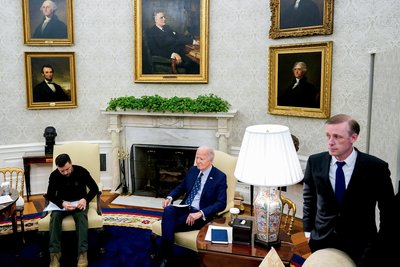
What I will say is that President Biden weighed decisions with input from his military and intelligence professionals. And it was my job basically to facilitate that conversation between President Biden, his military leadership, his intelligence leadership, and in certain cases made judgments about limitations.
He did that with a view that we wanted to do everything in our power to support Ukraine. But yes, we also wanted to ensure that we did not have an outbreak of direct conflict between the US and Russia and he felt that that was his responsibility as the American President over time.
As we saw opportunities to increase both the type and level of support ― we seized them all the way through, right to the very end of Biden’s administration. When we surged massive amounts of weapons into Ukraine, knowing that President Trump would be coming, and those weapons to this day are being used by Ukrainians on the battlefield.
And I'm very proud that in the end of the efforts and the work that we undertook to provide, in my view, an unprecedented and historic amount of military equipment to Ukraine from the United States and from 50 Nations and without President Biden in the Biden’s Administration. If someone else had been President, then I don't believe that you would have seen that level of support.
And one final, very short question, what do you think could serve as a credible security guarantee and deterrence mechanism going forward? How can Ukraine avoid the Budapest memorandum mistakes in the future?
Well, if you look at what the Biden Administration signed with Ukraine, it's a legally binding security guarantee document. And that document which President Biden and President Zelenskyy signed at the G7 Summit last year. The Trump administration should reaffirm it, stand by it, and along with all of the other countries that have signed those security guarantees
should come together in a common strategy to ensure that Ukraine has what it needs to deter any future aggression and to defend itself. If any future aggression occurs I think, is the best strategy going forward, it's there for the taking, and I would support the collective effort to seize that opportunity.
Thank you very much, Jake.