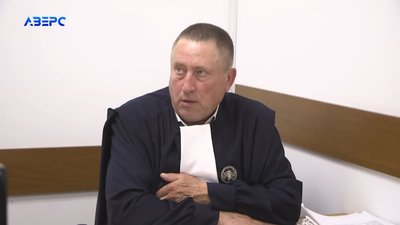
In early autumn, two videos with Vitalii Kovtunenko, the judge of the Lutsk City District Court, became viral on the Internet. In the courtroom, he criticized the work of the police officers who detained and took a Volyn resident to the military recruitment office. The judge insisted that there is no such a legal concept as “a person wanted by the military recruitment office”. According to him, a person can be declared wanted only by a court order.
The reports of the regional TV channel from the courtroom gathered over 1.4 million views and were actively shared on social media with comments like “the judge criticizes military recruitment offices and the police for illegal actions”, “men-hunters and their faithful accomplices”, etc. Hundreds of negative comments discredited the law enforcement system, courts, and the government in general. Although it is not formally called “the military office wanted list”, it does exist and the judge should know about it.
Due to the hype surrounding the video with the judge, the Suspilne investigative editorial office decided to figure out what “the military recruitment office wanted list” is, and what powers military recruitment offices and the police have during mobilization and whether they are sufficient for effective work. In addition, we looked into the biography of the judge, the video with whom was so actively shared on social media.
The case that was considered by judge Kovtunenko
From the court verdict of judge Vitalii Kovtunenko: in early July 2025, Volyn patrol police officers stopped a man who, according to them, was speeding. During a driver’s license check, they found out that the man was wanted by the military recruitment office, so they asked him to show his military registration documents. The driver replied that he had left them at home, but was ready to show the documents if the officers drove to his place of residence.
The patrol officers did not go with the man, but drew up a report under Article 185 of the Code of Ukraine on Administrative Offenses (malicious disobedience), and then took the man to the military recruitment office to draw up a report under Article 210-1 of the Code of Administrative Offenses (violation of the legislation on defense, mobilization training and mobilization).
According to judge Kovtunenko’s ruling, before taking the man to the military recruitment office, the police called two “unidentified persons”, who, according to them, were employees and authorized persons of the military recruitment office. The judge also noted in the ruling that the police indicated a different time of detention in the report, insisted that they could have drawn up a report on the spot, and also indicated that there was no “malicious disobedience”. The video from the police officers’ body cameras showed that the man “spoke in an exceptionally calm, balanced tone, and never committed any actions or allowed any behavior that would indicate his audacity or disrespect for the police”.
The judge closed the proceedings under Article 185 of the Code of Administrative Offenses on malicious disobedience due to the absence of an event and the elements of an administrative offense.
During the consideration of this case, judge Kovtunenko insisted, criticizing the work of the patrol police officers, that a person can be declared wanted only after a corresponding court decision. He said that the patrol officers had no reason to take the resident of Lutsk to the military recruitment office.
Another event that gained resonance occurred in the same month. The police accused a security guard of a Lutsk company of petty hooliganism and malicious disobedience to the representatives of the military recruitment office and drew up a report under Articles 173 (petty hooliganism) and 185 (malicious disobedience) of the Code of Administrative Offenses.
According to the police officers, the man allegedly cursed, pushed, and obstructed the mobilization activities of the military recruitment group. In addition, because of his actions, the violator of mobilization legislation allegedly managed to escape.
Judge Kovtunenko closed the proceedings in the case “due to the absence of an event and the elements of an administrative offense”. He noted that Article 185 of the Code of Administrative Offenses, under which the police accused the man of malicious disobedience to the military, applies only to situations when military personnel are involved in maintaining public order, not mobilization measures.
Powers of the military recruitment offices and the police
The mobilization system in Ukraine is formally simple: territorial military recruitment offices are responsible for maintaining military records, notifying and calling up citizens for service. They issue military registration documents, develop plans for the mobilization of people and equipment, and interact with local authorities to reserve those liable for military service.
In addition, military recruitment offices carry out explanatory work among the population, issue certificates of service, and consider applications from military personnel and their families.

They carry out all notification and recruitment actions within the limits of their powers, which are approved by Cabinet of Ministers Resolution No. 154 of February 23, 2022. Additionally, military recruitment offices involve other structures, primarily the police, but their powers are different, says Alina Yakovlieva, a lawyer at the Miller law firm.
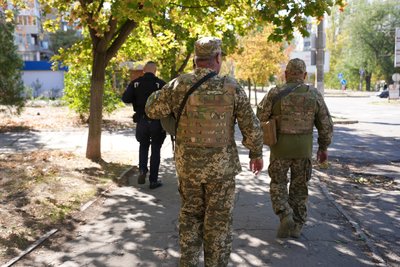
Representatives of territorial recruitment offices during mobilization events can issue summonses, but do not have the right to stop people or vehicles – only the police can do this.
“All cases when representatives of recruitment offices forcefully put citizens into a bus are an abuse of official authority. The law allows for detention only by the police, and only after drawing up a report,” explains Alina Yakovlieva.

As for the powers of the police, their representatives have the right to stop cars, check documents, and establish the presence of violations through the “Oberih” system, but they cannot issue conscription summonses. In practice, both structures often work together, for example, at checkpoints.
“Wanted list” of the military recruitment office
During martial law, citizens of conscription age must comply with military registration. In case of violation, they may be put on the wanted list of the military recruitment office.
Lawyer Yakovlieva notes that the concept of “wanted” in this case is rather a conventional term used for convenience.
If a citizen subject to military service is not registered in the military registry, does not come to the recruitment office upon summons, does not pass the military medical examination within the time limits provided for this, does not update data or does not comply with other obligations stipulated by Article 22 of the Law of Ukraine “On Mobilization Training and Mobilization”, representatives of the National Police, upon request of the head of the recruitment office, are obliged to detain such a person and deliver him to the recruitment office for drawing up a report on an administrative offense in accordance with Articles 210 and 210-1 of the Code of Administrative Offenses.
This is provided for by paragraph 15 of the Procedure for conscription of citizens for military service during mobilization for a special period, approved by the Resolution of the Cabinet of Ministers of May 16, 2024 No. 560.
Yakovlieva explains: in order to bring an offender under articles on violating military registration rules, police officers must conduct an administrative detention.
Article 260 of the Code of Ukraine on Administrative Offenses states that administrative detention is permitted for the purpose of terminating administrative offenses when other measures of influence have been exhausted, as well as for establishing the identity. Another condition for administrative detention is when the protocol on an administrative offense cannot be drawn up at the place of commission of the offense.
“According to Articles 261, 263 of the Code of Administrative Offenses, administrative detention is a temporary restriction of a person’s freedom of movement. A mandatory condition is the drawing up of a protocol on administrative detention, which indicates all the circumstances of the detention and data about the person,” says Yakovlieva.
That is, the lawyer adds, if a citizen has a violation of military registration and the police have confirmed this through the “Reserve+” application or their internal databases, then they have legal grounds to transport the person to the nearest military recruitment office.
If no violations are detected, but the police send the person to the recruitment office without official grounds or a protocol on administrative arrest, then this is a violation of the rights of a citizen and an abuse of authority by the police, Yakovlieva states.
“Citizens should know: military recruitment representatives must not bring people to the recruitment office on their own, this is done exclusively by the police. And the police can act only in the presence of substantiated violations and in compliance with the procedure. Therefore, the fact of violation of military registration is of decisive importance. If there is a violation, the police have the right to deliver a person to the recruitment office. If not, any forceful actions or restrictions on freedom are considered illegal,” notes Alina Yakovlieva.
“There is no official war. Martial law”
In early 2024, in an interview to the Volyn TV channel “Konkurent”, judge Vitalii Kovtunenko claimed, “There is no official war. Martial law.” And from the video with him that was shared this year, it seems that he openly opposes military recruitment offices.
However, we analyzed his court decisions and in a number of cases, he supported recruitment offices, recognizing their actions as lawful.
As an example, the plaintiff challenged the resolution and the fine imposed for failing to notify the military recruitment office of a change in marital status (birth of a child), explaining this by “ignorance”. Judge Kovtunenko dismissed the claim, noting that ignorance of the rules of military registration does not exempt from liability, and the recruitment office employees acted within their authority and issued the resolution properly.
Another resident of Lutsk ignored a summons to the recruitment office, for which he was fined. The plaintiff admitted that he received the summons, but refused to comply with it, stating that he considered the document “legally null and void”. In court, the man tried to prove that the recruitment office is not a legal entity and does not have the authority to impose administrative penalties. The judge found that the summons and the execution of the protocol were carried out properly, and the plaintiff’s failure to appear was groundless. He assessed the plaintiff’s arguments as personal judgments and manipulations that have no legal significance.
We decided to analyze the biography of judge Kovtunenko in more detail.
Vitalii Kovtunenko told about his path to law in one of his interviews: after serving in the army, he worked at the State Automobile Inspectorate in Kherson region, and in 2000, he started practicing law. According to the “Database of Maidan judges”, created by Avtomaidan activists, after completing specialized judicial training in 2006, Kovtunenko received his first judicial position in the Hornostaivskyi District Court of Kherson region. Since 2008, he has been working in the Lutsk City District Court of Volyn region. In 2011, he was elected a judge for an indefinite term.
During the Revolution of Dignity, judge Kovtunenko sentenced a Lutsk resident to house arrest as a preventive measure for hanging a portrait of Yanukovych with a noose around his neck on a Christmas tree. By doing so, according to the law enforcement, the Lutsk resident violated public order and showed cynicism.
In 2015, the High Qualification Commission of Judges of Ukraine, based on the results of considering the disciplinary case of activists from the “Volyn Self-Defense”, sent recommendations to the High Council of Justice to resolve the issue of submitting a motion to dismiss Vitalii Kovtunenko from the judicial position for breach of oath.
The reasons were “significant violations of procedural law and negligence of the judge”, “significant violation of criminal procedural law by the judge”, “a single gross violation of the rules of judicial ethics, which undermines the authority of justice”.
The judge appealed the decision to recommend dismissal to the Supreme Administrative Court, and the High Council of Justice therefore left the decision of the High Qualification Commission of Judges of Ukraine without consideration.
In 2015, the judge got in the news reports. Olha Taran, a resident of Lutsk, claimed that Kovtunenko had allegedly illegally purchased a house that the bank had taken from her for debts. The woman accused the judge of possible collusion with state registrars and of buying the house at an undervalued price. The lawsuits over the house lasted for four years and ended in favor of judge Kovtunenko. Currently, the house, which was the subject of the disputes, is owned by Vira Smokovych, the mother of Kovtunenko’s common-law wife, who is a judge of the Volyn District Administrative Court.
In 2020, the “CHESNO. Filter the court!” campaign indicated that Vitalii Kovtunenko violated all five integrity criteria: he was involved in making questionable decisions, violating human rights, violating the rules of professional ethics, criminal offenses, and violating the criterion of transparency of assets.
In the same year, the High Council of Justice brought Judge Kovtunenko to disciplinary liability for unreasonable delaying of the consideration of cases, including civil and administrative proceedings on corruption offenses. The High Council of Justice found that the judge violated reasonable deadlines, failed to consider the participants’ petitions, and unreasonably demanded documents not provided for by law.
We asked Vitalii Kovtunenko for a comment on his position, interpretation of concepts that caused a resonance on the Internet, as well as on his personal popularity. In the conversation, the judge replied that he was busy, although we called between court sessions. The next day, he said that he was having a lunch break, after which he stopped the conversation. We sent a list of questions via the messenger, but the judge said that he would not comment or explain anything and advised us to contact the court and the judge-speaker.
Judge-speaker of the Lutsk City District Court Andrii Podzirov noted in the comment that the statements of judge Vitalii Kovtunenko during court hearings, videos of which have gained public resonance, are a personal interpretation of the legislation that does not reflect the official position of the court.
This material was funded by the European Union. Its contents are the sole responsibility of the author and do not necessarily reflect the views of the European Union.