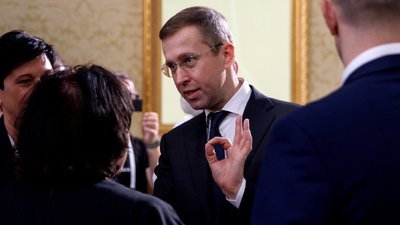

Serhii Mykhailyk, the psychologist of the “Children’s Voices” charitable foundation, works with teenagers who find themselves in crisis situations. They are often the target of manipulation and recruitment attempts through Telegram channels, in video game chats, or on TikTok. In the Suspilne investigative documentary “Access Point”, which was released on YouTube on July 27, Serhii Mykhailyk explained why Russian special services recruit Ukrainian teenagers and how they find ways to do this. We decided to publish a full interview with the psychologist to tell more about how parents can recognize alarm signals and what to do to protect their children from dangerous influences and potential recruitment.
I work mostly with acute physiological conditions in children, adolescents, and adults, as well as with their family members, who need rapid crisis intervention, says Serhii Mykhailyk. In one way or another, one third of them experienced attempts to be recruited or were “probed”. I often hear from my patients that people of pro-Russian orientation try to contact them, to communicate with them.
There were several cases when communication was established via messengers. It started with team competitive games, most often produced by Russian studios (for example, Standoff 2), but there were also cases with American games (Fortnite, Valorant, or Dota 2). Players were offered in-game currency. Teenagers were contacted via Telegram or Discord and got messages: “I can give you some money, but you need to do a small action”. There was a case when a teenager was told to call the Security Service of Ukraine hotline and report the mining. The child did not do this. There were cases when teenagers were tried to be recruited via TikTok: the recruiters wrote exciting comments under the video, and then offered to chat on Telegram.
What is the psychological condition of teenagers after such attempts?
I would divide the psychological condition into two options: it can be strong rage, a desire to punish and immediately report to law enforcement, to achieve justice, and vice versa, depression, a fear of what might happen. Often, when teenagers refuse to contact, they are intimidated. The recruiters say, “We will find your parents, we know everything about you”. After such communication, a psychologist needs to work with anxiety and fear.
Who is more difficult to work with: the first or second type of victims?
It is more difficult to work with the second type. The first type does not have such negative consequences as anxiety and fear. Aggression, if it is hypertrophied in a teenager, will still calm down after a certain time. This is safer than when a teenager feels anxiety and fear, since they are additional levers of influence for further communication.
Who is most vulnerable to recruitment?
In general, teenagers are a risk group for any manipulative influence because their critical thinking has not yet fully developed. They always have single-minded thinking: something is either good or bad. There are no borderline things, no middle ground. This is mostly called young maximalism. It is about a dichotomous evaluation of everything: the food is delicious or not, the movie is cool or I do not advise anyone to watch it. Since teenagers are often prone to such a dichotomous assessment of reality, they are more easily influenced, and it is easier to push them not to a neutral, balanced assessment, but in a certain direction.

In addition, among all teenagers there are certain risk groups. The most common is financial instability. For example, in a family that has moved or has financial difficulties, a teenager is much easier to be manipulated. How? You get money for what you want, that is, some kind of selfishness is used. You get money to help your family get out of conditional hardship. This can be the moment of manipulation.
The emotional component is very important. Since teenagers are not yet able to control themselves emotionally like adults do, certain neurotransmitter and hormonal changes occur in the body and because of this, it is easier to provoke emotions that can later lead to certain actions.
Another risk group are teenagers with psychological problems; those who do not have the proper level of understanding in the family, school, or social environment. A conditional teenager with anxiety, when he hears from some friend from Spain that he also “understands it all and has experienced it”, will much more easily make contact with him and share what he would not normally share. When the need for understanding is implemented in this way, it can become a point of recruitment.
First, emotional understanding and then pressure. Well, for example, you went to the store to try on things, so “send me the photos”. Then blackmail over these photos. If this is interaction with active teenagers – brave, for example – then it can be, “At your age, I did much more serious, more impudent things. And what are you doing now? The most you did was spray-paint some house. Try this. Can you?”
There are currently two main methods of influencing adults: financial and ideological. The first includes significant amounts of money. Adults have a more stable understanding of risks and cause-and-effect relationships, which adolescents do not yet have. Therefore, to encourage an adult to do something, you need to use more resources, more money. Adolescents are more profitable, cheaper. The second is the ideological component. However, there are now few such ideological reasons.
Teenagers are very rarely recruited because of the ideology, as it has not yet fully developed.
What is the role of teenagers’ upbringing?
The main one. Financial, emotional, psychological components – they are all about upbringing and interaction in the family. For example, there is a financial difficulty, and parents do not want to talk about it because it is uncomfortable for them to admit this. A teenager sees that there is a problem, but parents do not discuss it with him/her. There is no clear plan, they do not say, “Now it is a difficult situation, but I am working on it, we will get out of it”. Mostly, it is the financial component that becomes a lever of influence on the teenager when there is a problem, but it is silenced because it is unpleasant and they do not want to discuss it. This concerns upbringing – how to share, what can be discussed, whether there are taboo topics, whether you will be understood, whether your fears will be listened to.
Family life is not only about upbringing, it is also about the interaction between parents and their child.
How important for vulnerability to recruitment is belonging to subcultures or the influence of the immediate social environment?
The environment is very important because it largely shapes teenagers. There are three main groups that create a teenager’s social system: family, close circle of acquaintances, and wider systems such as school, sports club, gaming communities, etc. Most often, the family fades into the background, and friends and acquaintances come to the fore. Therefore, they actually have a greater influence on the teenager than parents do. However, most of the responsibility, both legal and social, lies with the family, the parents.
In the city of Rivne, teenagers were recruited through a community associated with drug distribution. How influential can such environments be in shaping the willingness to carry out criminal tasks?
If teenagers are interested in drugs, then most likely they have had their own experience with them or know about the experience of their acquaintances and friends. They are very interested in what this communication channel can give them. For a person who has something to interest them, it is easier to push teenagers to certain actions. In addition, being present in a drug chat and using substances reduce the chances that teenagers will contact law enforcement.
What are the signs with which parents can recognize that their children are being recruited? How to talk to children in such a case?
This can be an excessively depressed condition, physiological manifestations of anxiety (the child shudders, is very anxious when someone tries to look at their phone), insomnia. It can also be a sharp change in the circle of acquaintances, interruption of social connections, isolation and communication with one friend who is “very understanding”.

Communication with a teenager is rarely successful if it is hierarchical. They strive for a certain freedom of movement, isolation from parents, self-expression. “Equal-to-equal” communication will work: if you talk to a child as if he/she is an interesting interlocutor for you, this can be successful. You can watch a video or read the news about recruited teenagers and say, “Look, I am very concerned about what I just watched or read, and I would like to discuss it with you. Why do you think these boys or girls did this? Do you know cases when your friends were tried to be recruited, have you encountered such things in games or chats?”
It is important not to simply try to convey information in a directive manner, but to engage a teenager in discussion and interaction.
Do you see any changes in teenagers over the past few years? How is the current generation different from the previous generations?
Yes, it is different. A strong change is that this generation has been influenced by the war. The war led teenagers to show initiatives in favor of the front and volunteering. Now teenagers are radicalized, directed towards action. However, they can also be turned in the opposite direction.
Despite the rise of patriotism, many teenagers still consume Russian-language content. Why does this remain the norm? To what extent do you think this is a mass phenomenon?
Here we again see a dichotomy, that is, a polar vision. There are patriotic teenagers, and there are rather antisocial ones. This Russian-speaking vibe is a way of protest. For example, “I will speak Russian because you speak another language”. In addition, there is cultural inertia, social media trends, Russian songs, and more. For example, a sound is isolated from a video of some Russian blogger, which becomes widespread, and teenagers record, for example, on TikTok, lip-syncing to this sound. Memes in Russian are quite common. The availability of such content, in fact, pushes people to speak Russian.