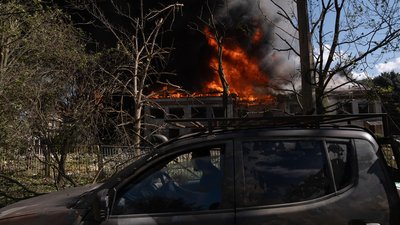

There are a lot of cars on the narrow road. This place is about 30 kilometers from the "Krakowets" checkpoint on the Ukrainian-Polish border and about the same distance from Lviv. The village of Shklo is close to the lively town of Novoiavorivsk with its high-rise buildings. There is a balneotherapy and mud resort of the same name in the village.
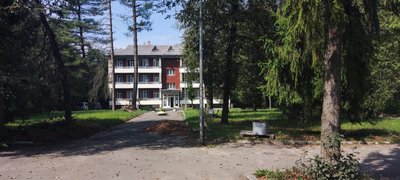
The parking lot in front of the sanatorium is empty. The administrative building looks abandoned, but the open entrance and the abundance of warning signs give hope that there is life behind the gate.
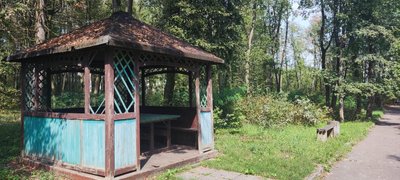
There is a glass security post in the administrative building. It seems that the security guard has just left for a few minutes and you can enter the territory without further explanation. The column at the entrance tells about the almost 80-year history of the resort. An asphalt road leads deep into the territory, which looks more like a wild forest than a park. The old paving slabs are overgrown with grass, and the trees on both sides resemble the trees in the Red Forest in Chornobyl.
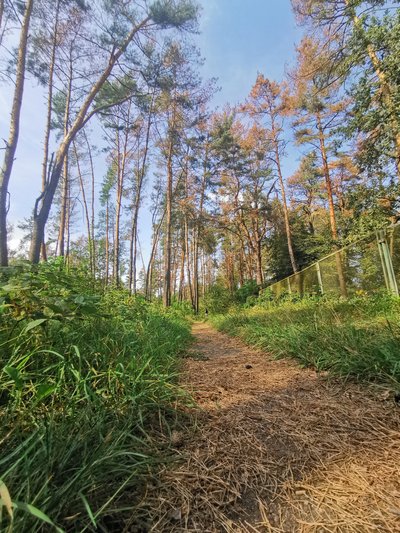
"It is probably a kind of tree disease," we share our impressions to one another.
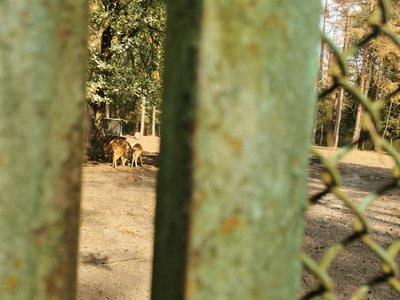
We see a fence near which children of primary school age are running. There is a woman nearby; she is picking up drawings and orange plastic chairs. We realize that the children had an art lesson here. In a moment, we notice spotted deer in the middle of the green-red forest. The children were drawing them.
Then, we see a multi-story facility; it looks like a residential building. There are several other building behind the first one. There are many buildings here. And here is a mineral water spring with old signs about its healing properties. We are taking photos.
"What are you doing here? Who gave you permission to take pictures?"
The man in the blue overalls is strict, but nervous. We explain that we are journalists. The conversation goes on. He refuses to say his name. However, he says that he had ten subordinates earlier, then only three. Now he does all the work himself. According to him, on Friday, August 23, all but a few employees took an unpaid vacation, the last guests left the sanatorium, and the employees have not been receiving salaries for years.
"If a group of at least 40 guests comes, maybe we will continue work," says the man. "When we were subordinated to the defense ministry, everything was ok for us: there were more than 500 guests at a time. But when the State Judicial Administration became the owner...," the man complains. However, he adds that the sanatorium’s affairs began to deteriorate in the 1990s when the resort was still owned by the Ministry of Defense.
However, he insists that it would be better to give the facility back to the military. "We have so many wounded people," he argues.
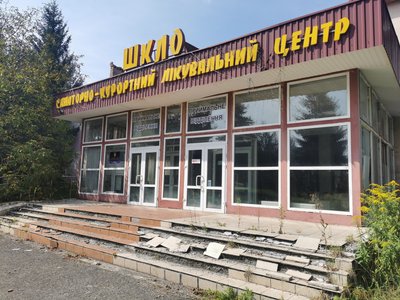
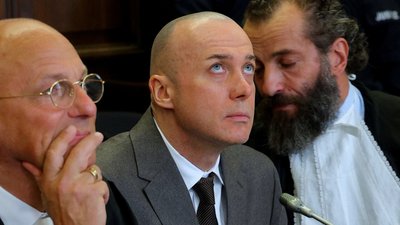
We came to the "Shklo" sanatorium because of a court case. The resort is being sued by its former long-time director Roman Kozak, the father of ex-MP and traitor of Ukraine Taras Kozak. He demands from the sanatorium more than seven million hryvnias.
While we were studying the case, we got to know that this state-owned enterprise, a place for the rehabilitation of the military, is now planned to be sold. The facility has almost 50 million hryvnias of debts.
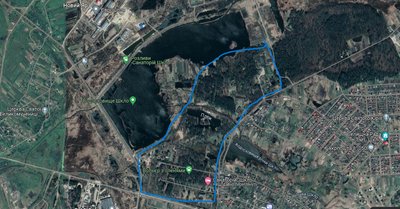
The Suspilne investigative editorial office decided to find out why the sanatorium, which has about 76 hectares of land with forests and water bodies and dozens of buildings, cannot get even 40 guests, although it offers relatively low prices.
With resources, but unprofitable
The "Shklo" sanatorium was transferred from the Ministry of Defense to the State Judicial Administration in 2003. The enterprise, as stated on its website, has its own sources of drinking slightly mineralized water "Naftusia-Shklo", hydrogen sulfide springs of low and medium mineralization, peat-mineral therapeutic mud, and phytotherapy and ozone therapy facilities. In addition, the sanatorium has a medical base and accreditation of a first-category health care institution.
According to the statute, the sanatorium must provide sanatorium-resort treatment for judges and employees of the judicial system. However, it is also available to any citizen of Ukraine.
According to data from the "Sanatoria of Ukraine" website, the cost of a double room with meals and medical treatment was 1,520 hryvnias per day.
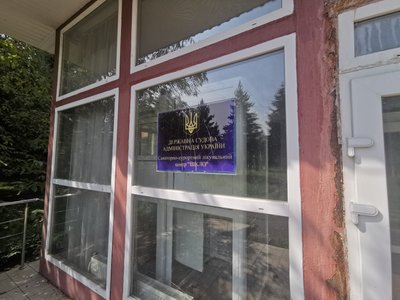
Currently, the authorized capital of the "Shklo" is 18 million hryvnias. At the same time, according to the analytical system YouControl, the sanatorium has a total creditor debt of almost 48 million hryvnias.
The company owes taxes to the state, salaries to employees, and payments for goods and services under contracts. One of these contractors, "Bioenergytrans" company, even filed a lawsuit to the commercial court to declare the sanatorium bankrupt due to a debt of more than three million hryvnias. The case is still under consideration.
According to the financial reports in the YouControl analytical system, a significant accumulation of debt began in 2018.
On the website of the Council of Judges, we found a decision regarding the sanatorium dated 2018. It says that the main negative factor in the deterioration of the financial situation was that since 2014, the Social Insurance and Temporary Disability Fund has reduced purchases of sanatorium-resort services.
On November 9, 2023, the Yavoriv District Court of Lviv Region collected more than 7 million 360 thousand hryvnias from the sanatorium in favor of the former director, Roman Kozak.
What money does the father of the ex-MP demand?
Roman Kozak was the director of this state-owned enterprise from September 2009 until the end of December 2019. He is the father of Taras Kozak, the former Member of Parliament from the "Opposition Bloc" party (earlier — the "Party of Regions").
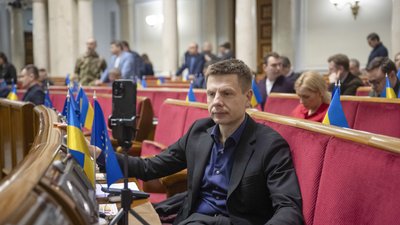
It should be noted that since May 2021, Taras Kozak and his associate Viktor Medvedchuk have been suspected of high treason and illegal appropriation of national resources in temporarily occupied Crimea. In 2023, President Zelensky deprived Taras Kozak of Ukrainian citizenship, and after that, the Verkhovna Rada excluded him from the parliament.
This year, the State Bureau of Investigation declared suspicion in absentia to Kozak’s brother Bohdan and Medvedchuk’s brother Serhii for tax evasion, and their confiscated cars were transferred to the Armed Forces of Ukraine.

Roman Kozak claimed in the lawsuit that on June 1, 2009, he entered into an agreement with the state-owned enterprise "Shklo" on the provision of interest-free repayable financial assistance for 7 and a half million hryvnias.
Deputy director Ihor Kukhar concluded the agreement on behalf of the sanatorium. Roman Kozak himself gave Kukhar an order for this as the then acting director. The "Shklo" sanatorium undertook to return the money by October 15, 2018, but did not fulfil the obligation. On October 1, 2021, Roman Kozak filed a lawsuit to recover funds from the sanatorium.
Kozak’s lawyer, Vasyl Medvid, confirmed the fact of the payment of assistance with the contract, receipts for cash orders, acts of reconciliation of mutual settlements, and letters from the sanatorium to the State Judicial Administration and the Council of Judges of Ukraine about the critical financial and material condition of the state-owned enterprise.
Oleksandr Kholodnyi, the then director of the sanatorium, filed a counterclaim in which he asked to declare the contract on reimbursement invalid.
In particular, there were comments on profitable cash orders, because they had different contract dates, improper designations (there was no word "repayable"), the total amount of issued orders was more than 7 and a half million hryvnias, and the first deposit of funds was in 2011, not in 2009.
In addition, the sanatorium and the judicial administration tried to prove in court that Roman Kozak could not give orders until September 2009, because he was in the status of an acting director. However, the court took into account the data of the Unified State Register of Legal Entities, which states that Roman Kozak was a director as of June 1, 2009 (then he became an acting director).
The court did not take into account the claim of the defendant’s representatives that such contracts had to be agreed with the State Judicial Administration, the owner of the sanatorium. According to the court decision, as of June 2009, neither the statute nor any regulatory act provided for such a need.
Kozak says he sold a factory
In a conversation with us, the former acting directors of the sanatorium, Ihor Kukhar and Dmytro Holovko, confirmed that Roman Kozak deposited funds into the enterprise’s account in order to pay wages to employees and various tax obligations. However, both former acting directors could not name the exact amount that Kozak lent to the sanatorium.
Roman Kozak himself claims that he contributed funds because there was no financing, and employees’ wages and taxes had to be paid, in particular, to be able to participate in bidding procedures.
"What can I say? I invested my money in the state property. And I am waiting for it to be returned. An interest-free loan to the state," Kozak told us. "The sanatorium will be transferred to the State Property Fund. There is a resolution of the Cabinet of Ministers. Then, we will figure out who will reimburse the funds to me in the future."
"It is desirable to transfer the sanatorium to the military, because after the war there will be many people who will need rehabilitation. There is mud therapy, hydrogen sulfide there. The main thing is that it is not closed. This is a strategic object," added Roman Kozak. He claims that he is ready to give the money, which will be returned to him, to the military.
We asked Roman Kozak why he did not deposit the money immediately in 2009, when he signed the contract, and where he got so much money:
"I signed an agreement, but then the sanatorium won a bidding procedure of the Ministry of Social Policy for 186 million. I thought, "Why should I invest now, I will wait for those funds." I made repairs in one of the buildings, changed the roofs because they were already leaking. Then they stopped giving funds. The boiler house was falling apart, and the heating line was falling apart. Of course, I repaired the heating system, paid taxes and salaries. People needed money for living. I have been in business all my life. I had my own clothing factory. I sold it for 500,000 dollars and invested the money in the sanatorium. Well, it was a stupid decision, but what can I do now? I made plans, I hoped, I believed in myself, and this is what happened. Now I am a pensioner. I do not work; I receive the pension."
In open sources, we have not found any mention of the fact that Roman Kozak was the owner of a "clothing factory".
In court, the representative of the sanatorium insisted that Roman Kozak could not have more than seven million hryvnias to lend to the enterprise. However, the court indicated that it was unable to verify this.
He cannot claim a share of ownership
The sanatorium and the State Judicial Administration filed an appeal against the decision of the Yavoriv District Court. The next court hearing is due in October.
The head of the State Judicial Administration of Ukraine, Maksym Pampura, commented for Suspilne:
"If the decision of the appellate court is in Kozak’s favor, I think it will be necessary, first of all, to hear the response of the sanatorium. The direct responsibility for conducting economic activity rests with the state-owned enterprise. Then, a decision should be made."
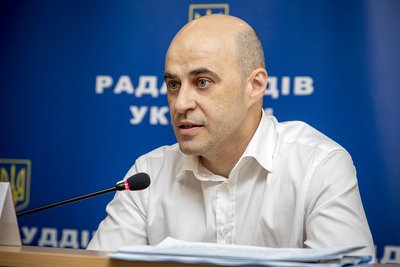
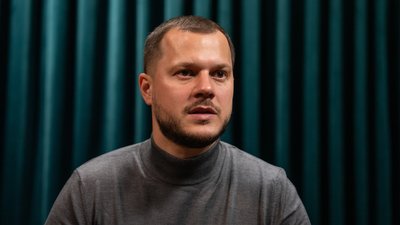
We asked Yevhen Vorobiov, a lawyer from the NGO "Platform for Human Rights", whether Roman Kozak can claim a share of ownership in the state-owned enterprise if he wins in the appellate court and the sanatorium does not have funds to pay off the debt.
Vorobiov said that there is a moratorium on the use of forced sale of property of state-owned enterprises, in which the state has a share of more than 25%. Therefore, bailiffs cannot sell the property to fulfill the court’s verdict on the recovery of funds. The government through the State Treasury will pay the debt in the event of a lack of funds on the bank account of the "Shklo" state-owned enterprise:
"In accordance with the Law of Ukraine "On State Guarantees for the Execution of Court Decisions", the state guarantees the execution of the court’s decision on the collection of funds and the obligation to take certain actions with respect to the property for which the state enterprise is the debtor. According to the general rule, the debt collector submits an application for the opening of enforcement proceedings. If the court’s verdict on the recovery of funds from the state-owned enterprise is not implemented within six months from the date of issuing the resolution on the opening of executive proceedings, its implementation is carried out at the expense of the funds provided under the budget program for ensuring the implementation of court decisions."
The sanatorium for privatization
While Roman Kozak was suing the sanatorium, in the autumn of 2022, the Cabinet of Ministers of Ukraine included the property of the state-owned enterprise "Shklo" in the list of those transferred to the State Property Fund for further privatization.
In response to the request, the State Property Fund informed us that the State Judicial Administration of Ukraine has not yet carried out this transfer, although it was supposed to do so within seven working days.
"The judicial administration has not delegated its representatives to form a commission on transfer issues and has not provided documents for the preparation of the act of acceptance and transfer," says the spokesperson of the State Property Fund Oleksandr Polishchuk. "The State Property Fund has repeatedly addressed the State Judicial Administration and the Cabinet of Ministers in this regard."
The State Judicial Administration of Ukraine, when asked why they did not comply with the order of the Cabinet of Ministers, reported that they supported the position of the Supreme Council of Justice, which in July 2023 made a statement that it was against the transfer of the sanatorium to the State Property Fund and its further privatization.
It was argued that, since the state-owned enterprise is located in a "conditionally safe" territory of the country, it could serve as a temporary shelter for employees of the judicial branch who are internally relocated persons.
The Council of Judges, which is the highest body of judicial self-governance and is responsible, among other things, for the legal and social protection of judges and their families, also started to defend the sanatorium.
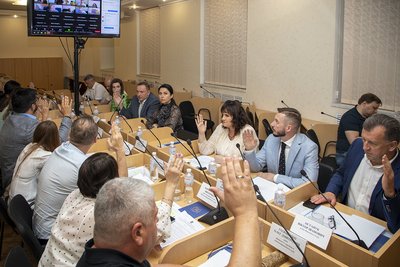
Prime Minister Denys Shmyhal instructed the Ministry of Economy to discuss the transfer of the sanatorium with the Council of Judges. However, as council member Valeriia Chorna told us, they have never been involved in this issue. On August 8, 2024, the Council of Judges appealed to the Prime Minister again.
Since July 9, Olena Vasylchenko has been an acting director of the sanatorium. She refused to comment on the affairs of the sanatorium, in particular, on the fact that it has stopped its operation. She said that she had only recently started performing her duties.
We asked the State Judicial Administration why, in their opinion, the sanatorium became unprofitable, as well as where they plan to get funds if they do not want to transfer the sanatorium to the management of the State Property Fund, and what development prospects they see.
Our request was responded as follows, "From July 10 to October 31, the sanatorium is conducting an internal audit regarding the financial and economic activities of the state-owned enterprise for the period from January 1, 2022 to June 30, 2024."
Why the sanatorium accumulated debts: the opinions of the former directors
From 2019 to July 2021, the "Shklo" sanatorium was managed by Ihor Kukhar, who was a deputy director in the times of Roman Kozak.
In a conversation with us, Kukhar explained that the debts arose because the sanatorium did not have enough guests, it worked only in the warm season, there was no financing, and there was not enough working capital.
According to Kukhar, there were ideas to make the sanatorium a place for military rehabilitation. They appealed both to the government and to the President’s Office with a request to transfer the property to the Ministry of Defense, hoping for funding. However, they received answers that this was possible only with the consent of the State Judicial Administration. There was no such a consent.
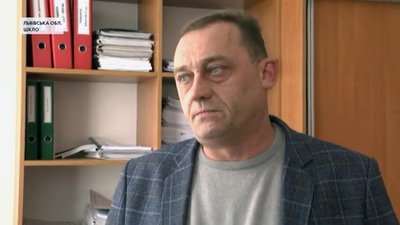
After Kukhar, the duties of the acting director were performed for three months by Oleksandr Udovenko, and then until July 2022 — by Oleksandr Kholodnyi. He applied for the position of the director of the sanatorium to the State Judicial Administration of Ukraine, but did not pass the special examination. In 2015, Kholodnyi ran for the Selydove City Council in Donetsk region from the "Opposition Bloc" party.
In November 2021, Kholodnyi appealed to the members of the Lviv Regional Council due to the difficult situation of the sanatorium and asked them to facilitate the transfer of the property to the the Ministry of Defense.
When Kholodnyi resigned, Dmytro Holovko, who had previously been Kholodnyi’s deputy, became the acting director.
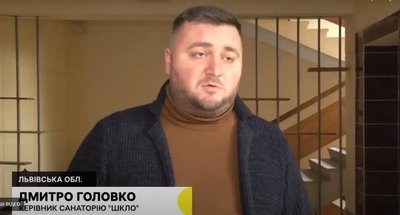
Before the sanatorium, Holovko was the director of the "Ofudservice" company, the shares of which belong to Maksym Radutskyi, the son of the "Servant of the People" party MP Mykhailo Radutskyi, and the "Madison" venture fund belonging to the "Opposition Platform — For Life" party MP Vadym Stolar. Holovko also managed Maksym Radutskyi’s companies "Mazaltov" and "Jersey Jet", which mainly deal with restaurants or food delivery.
Holovko was accused of official negligence during his management of the sanatorium. He allegedly paid the money under the repair contract, which was not fulfilled.
Dmytro Holovko claims that the repairs were made and does not consider himself guilty. Regarding the development of the sanatorium, he saw a prospect in the field of recreation and entertainment:
"I just really liked how the Exhibition of Achievements of the National Economy operated in Kyiv earlier. I wanted to do something so that it could be for everyone. So that everyone could go there both on weekends and on weekdays, so that people knew that there was something for everybody there: for children, adults. So that people could rest on poufs in the evening, listen to jazz or watch a movie in the open air."
This publication was funded by the European Union. Its contents are the sole responsibility of the author and do not necessarily reflect the views of the European Union.