


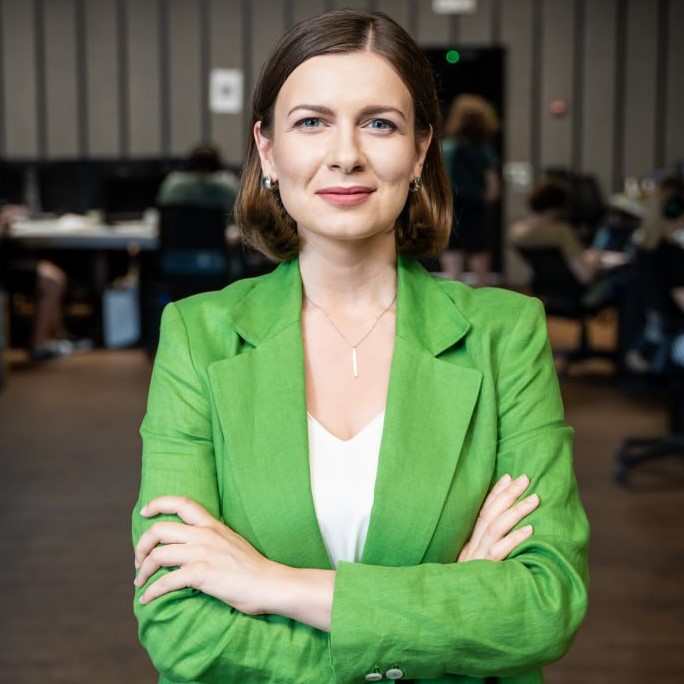
Dr. Meaghan Mobbs, US Army veteran and President of the RT Weatherman Foundation, volunteers in Ukraine for almost all of the full-scale invasion. Specifically, her team helps to bring the bodies of the fallen foreign military volunteers to their home countries — and ensure that their post-mortem rights are respected.
Dr. Mobbs joins Ukraine's Public Broadcaster to discuss US support for Ukraine, global threats stemming from unpunished Russian aggression, and why she disagrees with her father, US Army General Keith Kellogg, on the mobilization of women.
We are recording this interview as the security situation in Kyiv and the region deteriorates. There are constant air raid alerts in the capital, but what's worse is severe damage to the population, to their houses. What do you see as an objective of this relentless Russian missile and drone attacks on the Ukrainian civil population?
Well, first, anytime this happens – and I'm here quite often – this seems to be a significant shift even from just a couple of weeks ago in terms of how Russia is bombarding Kyiv in particular. Obviously, many other cities are under bombardment, but Kyiv, in particular, this last week especially, has felt it quite, quite significant and quite intense.
And I think the purpose is what Russia has always intended. They've always desired the capitulation of the Ukrainian people and the Ukrainian state. And I think that their intent is to degrade the infrastructure so much to make Kyiv unlivable in the hopes that the winter will be so bad that people will leave. Because if people leave, it's much easier for Russia to do its worst.
And so I think they want to terrorize the population and make Kyiv uninhabitable.
I don't think that'll happen, though. I think one thing I always find is no matter what Russia throws at Ukraine, Ukraine says, «We're gonna be here. We're gonna survive this, and we're gonna find a way.»
I want to make it clear to our audience that you are coming to Ukraine from time to time, so you are the one who's also witnessing what's going on in Kyiv and other Ukrainian cities. I'm not sure if we can say that – but maybe you got used to it?
It's what I see in all Ukrainians – you adapt. You figure out how you're going to adapt to this new circumstance in order to do the thing that you love, whether that's being a mother or it's being a wife or a husband or whatever it is. You understand that you have to get up the next day, and so you find a way.
I've been all over Ukraine: Mykolaiv, Odesa. I was in Zaporizhzhia last month. Kharkiv, Izyum, Chernihiv. And my experience has been that it doesn't matter ultimately what Russia does, because Ukrainians have said, «Do your worst. We're going to be here anyway».
Over the summer, there seemed to be a bit of a slowdown in the US efforts to influence the end of the Russian-Ukrainian war. In your view, what can the United States realistically do?
I believe we are the sole superpower of the world. And as a result, we have an obligation to do what's right on behalf of freedom and around our own safety and security. Having a safe, secure, sovereign Ukraine is in the best interest of the United States of America. And we should be doing everything possible to ensure that outcome. And that means doing everything from providing military aid to sanctions to intelligence support in order to force Putin to realize that he cannot win in this effort, and that everything he does, we will give it back to him twice over.
But until he realizes that, he's going to keep coming.
And so my feeling is that we both have a moral obligation as the sole superpower of the world. But also, we have an obligation as a country founded on those very principles that Ukraine is fighting for—freedom, freedom from tyranny, freedom to choose governance by its people. As long as a country is willing to fight for those things themselves, the United States of America should be standing with that country proudly and to whatever possible positive outcome we can achieve.
What could be a specific step or steps? Ukrainians know that there are going to be elections in the United States, and it sounds like the US has some work to do inside the country, so it may not pay so much attention to what's going on between Ukraine and Russia. What can be done this year, for example?
We can always ratchet up sanctions. We have quite stringent sanctions in place now, and more significant than they were previously. We have to just make sure those sanctions are enforced. If we don't enforce the sanctions that we have in place, then there's always economic loopholes that Russia can get around. So one is going to be really making sure that our sanctions are as strong as possible, that we enforce them.
Secondarily, we can absolutely, via cooperation, allow Starlink to be enabled in Russian territory [so that Ukraine can hit the places where Russians launch ballistic missiles] Again, it's always, you strike the archer in order to make sure there's less arrows instead of shooting down more arrows.
Additionally, we can encourage our partners to do more. Frankly, I look at some of our NATO allies—like Greece and Spain, for example, who have Patriot interceptors that can very well donate them. We should be forcing, as, again, the leader, both in NATO in terms of giving but also just the de facto leader of the West. We should be pushing countries like that to do more.
And then we can always provide or sustain the intelligence we're providing to Ukraine to allow them to do the incredible things they're doing with long- and mid-range strikes.
So it should be a combination of all of those things. 'Cause the problem is we've tried it in piecemeal. We've tried to do military aid with poor sanctions. Then we've tried to do really strong sanctions under this administration with no weapons. And I think the reality is we have to do all of these together in an interlocking fashion in order to achieve the outcome we want.
The highly anticipated visit of the US presidential envoys, Steve Witkoff and Jared Kushner, hasn't happened yet (the interivew took place on September 2; the visit finally happened on September 6. — Suspilne). And from your social media, it seems to me like you're a little bit skeptical of the fact that this visit still hasn't happened. Why is it so important for them to come to Kyiv?
Because I think every American I've ever known who has come to Ukraine has become a convert. If they didn't believe in the Ukrainian cause previously, and they came here skeptical, they walked away in love with this country and its people.
And my hope, my fervent wish and desire is for Witkoff and Kushner to come here and recognize what a grave mistake they've made, that they have failed to understand and appreciate the resilience of the Ukrainian people. They failed to understand the reality of this conflict, of what's happening and what Ukraine is fighting for.
And so, I am skeptical they're going to come. But I'm still gonna retain hope that they will. Because I love my country, and I love America, and I want us to do the right in the end. So I do hope they come, and perhaps it's in the works right now.
We saw that there was a visit of a CIA director to Moscow. How unusual or significant this visit is?
Because in Ukraine, of course, people paid attention to the fact that the previous visit of a CIA director to Moscow was right before Russia started its full-scale invasion of Ukraine.
We don't dispatch the director of the CIA for something small, right? So I would say it's quite significant from a variety of perspectives.
Number one, Director Ratcliffe has helped sustain the intelligence cooperation between Ukraine and the United States of America in an extraordinarily positive fashion. He's much more in line with understanding how you force Russia to an end state than I would argue almost anybody else in the administration. So the fact of the matter that it was him is a positive thing in terms of his understanding of the necessity of cooperation with Ukraine.
Additionally, if the reports are to be believed, he delivered a very, very striking message about Russia's failures on the battlefield. By the way, I also believe he was probably delivering a message around helping Iran, and saying, «Don't do that. Knock it off, or we're gonna do something in retaliation.»
But certainly, I share the concern: is there a sign of escalation to come, and we went there saying, «If you do this, it's gonna be a very bad thing»?
The problem with that is deterrence is based on capability, which is your ability to actually do something, and the capacity, meaning you can actually do that thing, and then communication. Does the person you're telling that message to actually believe it? So capability, capacity, and communication.
So it sounds like we communicated, «Don't do this.» We have the capability, 'cause we're the United States of America. Do we possess the capacity, which is willpower? Should Russia cross whatever red line we said not to cross—do we have the resolve to then punish them if they do cross it? And that's where I'm just a little afraid. That if we set a red line with Russia, we better be willing to enforce it.
One of the theories on what's behind this visit is that Russia may be preparing to attack one of NATO countries on its eastern flank. Do you think this is a possible scenario?
First off, let's be clear: they're already attacking NATO—with hybrid war. They're already doing cyber attacks. There's already been evidence of sabotage attacks that are occurring. There's obviously been drone incursions.
So, from my perspective, the West is already under attack. We just seem to be unwilling to recognize that Russia, China, Iran, North Korea are actively working to attack us all.
Now, when it comes to what you just mentioned—a genuinely kinetic attack against an eastern flank NATO ally. I see that less than I see potential markers that Russia is moving towards some type of full mobilization or even partial mobilization. And I could see in the context, in particular, of our elections, us saying, «Do not do that. Do not partially mobilize, or do not mobilize and escalate this war even further.»
A critical question in US-Ukrainian relations is the appointment of Ukraine's ambassador to the United States. As of now, as of this moment, there is no ambassador and no official statement's been made who's it gonna be.
But if you could provide a piece of advice to this future ambassador of Ukraine to the US, what would it be?
Unfortunately, it's a bit like a unicorn, in the sense that all the things I would hope they have would be extraordinarily difficult for any one person to possess.
But—their English has to be obviously fantastic. They have to understand all of the political nuances of the United States, which is extraordinarily difficult. But they have to be able to… I'm gonna say this phrase—to speak MAGA. That means talk to the party on the right in a way that is understandable, consumable, makes sense, feels genuine.
While also being able to speak to the left. That's important as well. And so they have to be able to do that and kind of appropriately navigate between those two things.
I think they have to understand the defense industrial base. They have to be able to communicate in the language of national security between both nations. And they just have to be savvy when it comes to all of these different things. Good with media and all of that, which is an extraordinarily tall order for any one person to possess.
And when you say that this person should have an ability to talk both to MAGA and also to the left-wing politicians and activists, you mean that this person should not choose a side?
No. There shouldn't be a side. And I feel this way about my support for Ukraine. It shouldn't matter if you are MAGA, Republican, or Democrat—we should all be supportive of the cause of Ukraine. In the same way that Ukrainians should love America for Americans, they shouldn't just love Democrat Americans or MAGA Americans. That inherently our causes, our nations are so intertwined and interlinked from a values-based perspective, from a security perspective, that whoever comes to America should be able to deliver that message to both sides of the aisle.
But also in a language that resonates. Understand what moves a MAGA voter, understand what moves a left voter, and be able to appropriately tailor their delivery to those audiences.
That's not a lie. It's not manipulation. It's just being savvy in the political space.
I'd like to talk a little bit about you. Because when we talk about volunteers or experts who deal with Ukrainian topics or work in Ukraine, there is usually some kind of a personal story behind this. Especially when we talk about people who are from countries geographically so far away from Ukraine. What's your story?
I wish I had some beautiful story to tell you. But unfortunately, I don't have a connection personally to Ukraine. Everything has become personal since then, if that makes sense.
I was doing work helping do evacuations out of Afghanistan. So, when the fall of Afghanistan happened in August of 2021, I was working alongside the two founders of my foundation to help evacuate our Afghan allies out of Afghanistan.
And we were doing that work, and we were still doing that work in the early months of 2022 when the full-scale invasion happened. And one of the things the founders and I had often talked about was, gosh, the American government fails all the time. Ukrainian government fails all the time. Governments fail, right? All the time. And what I've always loved about my country is even if the government fails, the American people will show up.
So we showed up for Afghanistan. And so when the full-scale invasion happened, the founders and I were like, «Well, we can't walk away from this,» that we're gonna find a way to show up for Ukraine. Because even if our government pulls out, America will be there if it's her people.
And so we immediately decided that we had to do something. And then that's become kind of a much, I think, bigger project and bigger commitment than we ever thought possible. But it's because when we came here, what we found was such a remarkable testament to all of those things I just professed to love about my own country–freedom, the desire to self-govern, the desire to protect the people that you love, whether it's your children or your spouse or your parents. All of those things, we just couldn't walk away from it.
You're also a US Army veteran. And it's interesting, as someone with a military background, is there anything that surprised you or struck you in this war?
So at first, I mean, I was smiling as you were asking that 'cause I love soldiers. I love people that are willing to fight. And the fighting spirit in Ukraine, the willingness to give everything for what you love, it speaks to a soldier's heart. I feel that so very deeply.
But what I was surprised by is… My wars were Iraq and Afghanistan. I served in Afghanistan. So the wars that I saw in terms of intensity were such a low level compared to what's happening in Ukraine. And I think there is such an unappreciation, especially in my country, of how intense this type of fighting is. And I don't think we're prepared to fight this way. I don't think we're prepared to sustain the losses that are gonna be necessary if we fight this type of conflict. And so my fear is that, yeah, we're just not ready for what's happening here.
Recently on your page on X, you paid attention to a very interesting trend — specifically that certain American commentators started focusing a lot on the issue of forced mobilization in Ukraine. Particularly, on cases of human rights violation during this conscription process.
Tucker Carlson is one of those who comment this very actively.
What do you think is behind this interest?
First of all, I wanna separate... Like, we can condemn malpractice around conscription and say there's been some of these violations of human rights, there's been some challenges related to conscription, and we can say that is bad. And as a country that's committed to democracy and to all of the necessary freedoms that are God-given to all of us, that we should condemn those conscription violations. While also acknowledging that citizens of a nation have an obligation to their country when it is facing an existential threat of annihilation. That citizens have an obligation to serve, to give to their country.
So we can condemn conscription violations while also saying that conscription is necessary at times when you face a perilous moment in your history. And so what's happening is that there are some very bad actors, and Russia is one of them. So when I say «bad actors», I mean both genuine adversaries, nation states–like Russia, Iran, North Korea, and China. And then I think just some bad actors that are just malign. They may not have an allegiance to those countries but are just malign, they're trying to undermine the West.
They are amplifying these videos as a way of saying, «Ukrainians don't wanna fight. Ukraine is bad. Look how they violate human rights.» That none of them really wanted to fight anyway. «They're being forced to fight by America», or they're being forced to fight by this, like, grand cabal conspiracy theory of CIA people pushing Ukrainians to the front.
And their purpose, the reason why they're doing that is they want to erode the West's willingness to fight. Because this war is coming for all of us. This war is in Ukraine right now, but this war is at all of our doorsteps.
Sorry, that was, by the way, one of my follow-up questions. Do you feel, as a citizen of the Western country, that picturing the conscription process as an evil is a threat to Western countries and their societies?
Of course. Let me be very clear. We had our own challenges with conscription and mobilization during our world wars. World War I–we put people in solitary confinements, we chained them to walls. We've had our own long history with conscription challenges. Because any time you are mobilizing a population to fight a war like this, you're going to have people that resist, you're going to have bad actors that are gaming the system. You're gonna have all of these things.
But what they're trying to do is exactly what you said. They're trying to make conscription, or the necessity of fighting for your country evil. Because they want all of us to lay down our arms. They want all of us to say, «You know what? It's okay. I would rather live on my knees than die on my feet.»
That is complete opposition to everything that we believe as free people, that we are willing to fight on our feet, and if that means die, okay, but we're willing to fight for what we believe in.
But they're seeding this narrative they'd much rather us be passive. Lay down our arms, don't fight, conscription is evil, obligations to citizenship are evil. 'Cause the hope is that in the West and in America, we decide fighting isn't worth it anymore. And that would be a very dangerous thing for the entire world.
Recently, you also commented on the issue of women in combat roles.
To give our audience just a short context—coincidentally, around the same time, two prominent, for Ukrainians, figures, made statements regarding the mobilization of women in Ukraine. [One was] your father, General Keith Kellogg, whom Ukrainians always listen with great interest. He made a statement. And also–former Ukrainian Defense Minister Oleksiy Reznikov commented on this.
You saw the reaction it sparked.
As a female veteran, how do you see this—how should the state approach the issue of recruiting women, especially when there is a war ongoing in your country?
Women should be recruited. This is what I believe. And this isn't to... I think people sometimes think that my dad and I are always exactly of the same mind.
Not in this case.
Not in this case, yeah. We have differences of opinion all the time. And this is one where we differ.
I mean, I will say, his frame of reference is me, who volunteered and went to Afghanistan, my mom, who volunteered and went to Grenada. And so he's like, «Women can fight, so why not? They should, they should fight.»
Where I disagree is they can fight, but they should volunteer to do so. And they should be recruited.
And there is a whole variety of reasons why I believe in this, and we don't have time to get into them now. But women inherently, when presented with the case of fighting for their country, if they're trained appropriately, they're properly equipped, properly armed—they will fight. That doesn't mean they're always gonna be in the trench. And I certainly wouldn't say, by the way, that we should erase the differences between men and women. Men and women are different, and that is okay. We should embrace that reality.
But women are excellent medics, logisticians. And sometimes they're excellent shots, by the way. We're very good at firearms. We're also experts at gathering information, like intelligence, and getting places that men can't. We should have women volunteer for the roles in which they're best suited, and then find ways to encourage other women to join them.
But I don't think at this time it is in the best interest of Ukraine to conscript its women.
I just want to emphasize one more time for our audience that there were no statement from the Ukrainian governmental official in favor of the mandatory conscription of women in Ukraine, during these years.
So these are mainly some [personal] thoughts, statements discussed by people who have some relation to the military sector.
I've asked you about your personal story, but it's also interesting how did you and your colleagues end up with such a unique and very difficult niche—repatriating foreign nationals who fought for Ukraine [and were killed in action] back home?
First off, I wanted to take the opportunity to talk real fast about my team. I have the most incredible group of people working in Ukraine. I have Americans that are here, but I have 19 Ukrainians who have become like family to me. The love they have for their country and for our work is a remarkable testament to who they are as people, but also I think to the purpose we have and what we do.
We actually do a lot of things, but one is the repatriation of foreign volunteers. And it's because they understand–in particular, the Ukrainians on my team–that these boys, these men, came here when they had every reason not to. They got on a plane, flew across an ocean to a country that none of them had ever been to for the most part. And then not only to come and serve, but to end up fighting and then dying for a country that wasn't their own.
And to honor that service and sacrifice is something so special and so unique, and the kind of combination of the Americans on the team and the Ukrainians that do this together is emblematic of what I think the relationship between America and Ukraine should be on the whole. Which is a remarkable giving of each other to something in service of both of our countries.
We got into this because in 2023, I had heard that an American who was—him and I were belonged to the same scholar community—that he had been here, and he had gone missing. And had been missing for quite [a long time]—since early 2022. No one had heard of him. There were rumors that he had been captured. There were rumors he was wounded. Nobody knew. But this set off almost a year and a half long search for this American, Grady Kurpass, who we eventually found. And we brought him home.
And in doing that, we recognized there were many Americans that had to be brought home. There are also many other foreigners that had to be brought home. And so now we work with over 33 countries, over 300 families. Working to make sure that if someone comes to fight and die in Ukraine, they will be brought home with the dignity and honor they deserve.
How many cases of repatriating foreign volunteers to their countries of origin have you dealt with during these years?
Oh my gosh, dozens and dozens. We don't just do repatriations, though. We work with these families to ensure that all the obligations of service are met to them. Whether it's ensuring that death certificates are issued in the case if they're a missing person. We've worked with the Ukrainian courts to petition for death certificates, for compensation related to being wounded in action, killed in action, missing in action. Sending home personal effects—moms want their last things home from their son. So, making sure those things are returned home.
And then also just building bridges between those foreign nations and here in Ukraine. Making sure that they understand that when their son or their husband came here, fought and died, that Ukraine honors them. That Ukraine remembers them. That it wasn't in vain, that they were giving themselves in service of something so much greater.
And so we work with the families to make sure they know that they're not alone in that journey.
When you talk to the families of those who were killed in action, do you often have to deal with a misunderstanding? «Why my son, or my husband, or my brother did this and went to Ukraine so far away from his country»?
Of course. I mean, there are some that didn't even tell their loved ones where they were going or what they were doing, or said they were coming and they were just going to be volunteering or they were gonna be with an NGO, and then never told their family that they were fighting on the front.
And then many—I'll speak about the Americans—many of them are veterans. And so their families have the experience of, you know, being part of the American system, which is quite robust, quite well-funded, established. And so their expectations around all the things I just mentioned–notification, compensation, repatriation—is rooted in the American system.
The Ukrainian system is still in some ways very young comparatively. And certainly is over capacity and not capable of meeting all the needs of the foreign volunteers in particular.
And so there is a lot of misunderstanding of that. And we have to be very careful as we never want misunderstanding to turn to hatred or a belief that Ukraine doesn't care. Because the Ukrainian people care very deeply and love these foreign volunteers that come and fight.
And so we are grateful to work alongside partners now to make sure that from the official Ukrainian side, we are beginning to address some of those misunderstandings.
What are the main misunderstandings? Because I was just trying to think about this, how this all looks for foreign volunteers in the Ukrainian army. Sometimes Ukrainian nationals face a lot of violations of what they should have received from the state as a military servicemen, and they don't.
So how does it look like for foreign volunteer fighters?
It's very similar. It's funny 'cause a soldier's problems is a soldier's problems irrespective of nationality. But it's everything related to the things that their service entitles them, whether it is compensation if they're killed or they're missing, their personal effects. I will say there's a huge challenge with making sure the families receive an official notification of the death of their loved one, and they're not finding out via social media. Which is, I think, a challenge for all families, not just American families or foreign families.
So those are some of the largest ones in particular.
And then just making sure... We have a deep tradition—we never leave a fallen comrade, meaning if someone is killed on the battlefield, we will move heaven and earth to get them home. And when we return them home, we do it in such a dignified way that their service and sacrifice is honored and memorialized.
And we wanna make sure that tradition is carried on from Ukraine to all of these foreign nations to ensure that this continuity of values exists.
Unfortunately, there were times there's been a lack of understanding of the cultural aspects of the return of loved ones, especially on the American side. We address those misperceptions quite a lot, to be frank.
You interact a lot with foreign citizens who come to Ukraine to fight for it. What can you tell about these people? Why do they usually do this? And is there a difference between those people who came [to fight] in 2022 and who are coming now?
Yes, there's a vast difference between people that came in 2022 and those that are coming now for many different reasons.
Those that came early on, were veterans of their country, whether they're New Zealanders or they're Brits or they're Americans. Inculcated in all of us is this belief that you stand up for what's right. And I watched my generation of veterans fight in two wars, Iraq and Afghanistan, that the wars were murky. It wasn't black and white. It didn't necessarily feel like a good war, if that makes any sense.
In our lifetime, this has been the first truly good versus evil war that we've seen. And soldiers run to where the fight is happening. I think many foreign veterans saw what was happening to Ukraine, who was truly the good in the situation, and wanted to make sure they did their part in helping the good guys.
Over the last year, we hear this often from Ukraine's political and military leadership that Ukraine would like to recruit more foreign citizens, especially for assault and infantry roles. How do you assess the potential of this idea?
I've talked about this on my X channel. Sometimes I say things that get me very much in trouble on X, and then I realize later I perhaps should have waited to say that.
But – I think this is a huge challenge. I will say I'm supportive of the idea of having a robust foreign legion if the infrastructure is in place to support it. Meaning that their rights are not denied, that they're capable of training and employing them effectively. Because otherwise I think it's a recipe for disaster.
On top of that, I think that Ukraine should be very, very invested in having foreigners come fight for Ukraine around values more than money. If the draw of having someone here to fight is around money, you begin to have the erosion of the necessary value system that sustains a democratic army. They have to be fighting for something, and fighting for a dollar, you begin to have challenges related to morale, related to cohesion, and related to all of the things you want for an army to win.
Additionally, I think it presents Ukraine some substantial challenges related to who are you bringing in? Because there's already been stories about Colombians that have come in and have gone back on the sides of the cartels. I don't think Ukraine wants the story to be that those that came here to fight for them and learn drone tactics are now helping kill innocents in other countries or utilizing it to forward cartel behavior in different parts of the world.
So I'm not against the idea. But this has to be done smartly in the right way, or it could be a very big disaster for Ukraine.
But if we speak in terms of idea versus money, I think it's a very debatable topic. Even if we speak about the conscription process regarding Ukrainian citizens—it's been a long war already, and it's quite difficult to engage people just basing on ideas. So maybe money is a better motivation.
Money is a motivator for almost anybody, right? Inherently, we have to have money to do things to live in this world that we live in. But I think that still it's very different for money to be a motivator for a Ukrainian—this is their country—than money being a motivator for a foreigner that comes. Because there still is an obligation of citizenship inherent in that Ukrainian, at the heart of them somewhere, there is that piece that understands this is their home country. And that does matter. That does matter.
And so I think that, sure, as wars go on, motivations become different. But I think it's a very dangerous thing to say it's an apples to apples situation where someone that's a Ukrainian fighting for things that may be not values and a foreigner doing that same thing.
Based on your observations, how does the Ukrainian government treat those foreign volunteers who are already in this fight? So what are some problematic moments you would like to outline?
There's some great challenges. Some of them are related to citizenship and anything necessary for them to logistically keep their lives here going, like being penalized for not being able to appropriately get to a place to file their documentation on time because they've been fighting.
I mean, my feeling is if you've been fighting here, you should be granted citizenship. If you have given to this country of yourself, then there's a kind of a reciprocal obligation of this country to give back.
So certainly navigating challenges related to citizenship. But even just related to extended stays here in the country, like visas, for example. People have overstayed their visas because they've been fighting for years and then hit with fines for overstaying their visa even though they're here fighting under the Ukrainian flag.
So, simple things like that. Also, making sure that their rights are upheld if they change units or they're capable of changing them.
And then certainly employing them in the means that they should be employed, right? I think the idea that you're gonna recruit a bunch of foreigners, and you're publicly saying to them you're gonna send them to the front line to the trenches is not perhaps the best way to recruit more foreigners coming in. If you're gonna recruit high-quality foreigners coming in, it should be with specific skill sets to employ them effectively for the broader defense. What you should never create is a tiered system in which certain populations have more rights than others. And I think unfortunately in some cases–not all, but in some–that's been the case where foreign rights have been placed lower than Ukrainian rights.
I just want to clarify for the very end. You outlined this issue of granting citizenship—are there a lot of foreign fighters who would like to receive Ukrainian citizenship?
Yes, absolutely. They see their lives here now. Many of them are dating Ukrainian women, are marrying Ukrainian women, which by the way is a fantastic thing because Ukraine needs more Ukrainian babies. And so if you could have a blended family by which you have a foreign volunteer here who then marries a Ukrainian woman, and they have a child, that is a net positive for Ukraine. Because it's building the economy. It's building the demographics of this country.
So, yes, there are many foreigners I know who would gladly take on Ukrainian citizenship. But the pathway for doing so is quite complicated.
Just for the very end—do you have a chance to talk about these problems with representatives of the Ukrainian government?
A little bit. I tend to stay away from the Ukrainian government, for a whole host of reasons. But where possible, I always want to advocate for the things that I feel are right. Not just for the people I represent but also for this country that I love and the people that I love here. Because I do feel called to make sure that if we can, we absolutely should do what's right and stand up for what's right. So where possible, I have highlighted this issue.
Dr. Mobbs, thank you very much for your time.
Thank you very much.