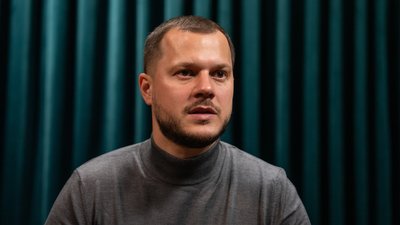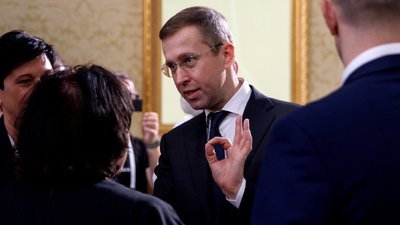

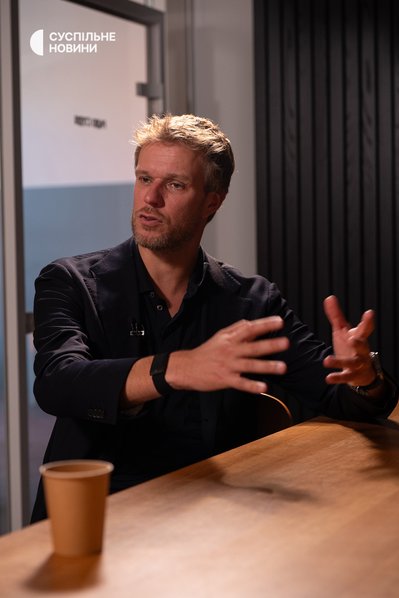
“We’re like that cartoon character drinking coffee while everything is burning around him, saying, 'It’s fine,'” – this is how formerSince September 2025, he has been a fellow at Stanford University (USA). Lithuanian Foreign Minister Gabrielius Landsbergis described Europe’s current policy. He has visited Ukraine 14 times since the beginning of the full-scale invasion. Landsbergis believes that Europe reacts only after Russia’s aggressive actions, whereas it must act proactively. In an interview with Suspilne, he spoke about Russian drones violating Polish airspace, Trump’s policy toward Ukraine, Europe’s ability to abandon Russian energy resources, and Ukraine’s prospects of joining the EU.
Mr. Landsbergis, first of all, thank you for visiting Ukraine during wartime and for your lasting support for Ukraine. Thank you.
Thank you for having me.
Last night was difficult for Ukraine again. How did you spend it? Did you hear any explosions?
Well, not this time. I had just a couple of hours in a train carriage, so I spent the time reading the news about what was happening in Poland. When I disembarked and went to the hotel, my taxi driver informed me that the attack was just over. But I visited Kyiv half a year ago, so I had the chance to at least hear what Kyivans are hearing every single night — the relentless attacks, which have intensified after the inauguration of the new administration in the United States.
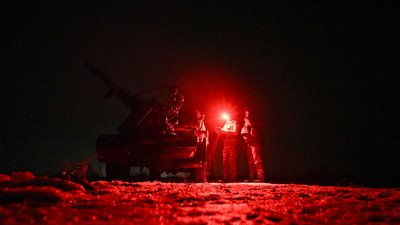
Speaking of Poland, Russian drones violated Poland's airspace. Poland is under NATO’s umbrella. What measures or real steps can we expect from NATO — something concrete, or only statements of concern?
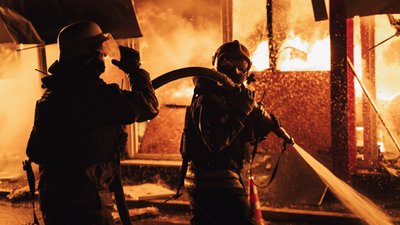
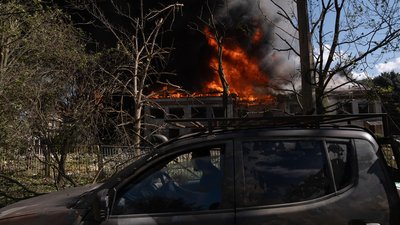
So far it’s been mostly a concern, which, at least in my mind, is no longer enough. We are approaching a situation where we cannot avoid admitting that our house is on fire. We’re like that cartoon character drinking coffee while everything is burning around him, saying, “It's still okay.” But we have to admit it’s no longer okay. This is a clear escalation—an act of aggression against a NATO country.
Now, the reasons behind it could be several. One is that, as with many things regarding the West, Putin is testing limits — checking reactions and establishing a new reality. If there’s no proper reaction, we can expect that that continues. There could also be additional thinking into Putin's strategy and one of those things is putting pressure on Poland, especially when knowing there are divisions between the government and the president now. That could be an opportunity, for example, to even limit Polish help to Ukraine. Poland is vital as a transit route for equipment reaching Ukraine. Imagine if a debate would start in Poland: “We’re under drone attack — maybe we should help Ukraine less.” That would be incredibly harmful and a major success for Putin.
So we need to be ready with an answer. I always say this. There should be an answer: no drones will be able to fly in, and then the support for Ukraine. An air shield over Ukraine would be an excellent response to the current situation.
You mentioned the possibility of Poland reducing its help for Ukraine. Do you think that is a real risk?
It’s a hypothesis, of course. This is still a very fresh situation. On my way here, I was trying to think: what would the Russians expect to achieve? Fourteen drones flying into Poland — that's not a mistake. Clearly, it’s a message. The message is they wanted to achieve something. So there are several elements. Poland politically is now in a tough situation. So adding more fuel to the fire will be beneficial to Putin.
We have to be vigilant. But again, I worry that we are reactive — waiting for these things to happen and then we have to think about the answer. I would like to see us pushing forward, not taking steps back.
Doesn’t this also show that NATO countries — those under NATO’s umbrella — are not as safe as they think?
That’s the right question. I believe that this is also one of the real goals or just a collateral goal. People in NATO countries, especially closest to Ukraine and Russia like my country, may start doubting [NATO’s protection]. This is what we have been seeing with hybrid attacks: something happens and then there is no response by NATO. Even NATO doctrine is formed that if it's hybrid, so the civilian infrastructure is damaged, something is burned down or bad things happen, then it's up to the country to figure it out on its own.
It’s one thing for Germany, a huge country, to handle that on its own, but it’s very different for a country of 2.8 million people, like mine. That’s why I’m sure these incidents will increase tensions in societies. People will start rethinking whether they do trust NATO and how much. That’s why we must push back.
Now I want to ask about Trump’s policy. Last time Suspilne recorded an interview with you, you said that with Trump in power, Ukraine and Europe were alone against Russia. Do you think we are still alone, or can Trump change his policy? Because recently we’ve also seen some critical remarks about Putin from him.
In practice, I would repeat what I've said in the last interview. The problem is we’ve lost a lot of time — and Ukraine is the biggest example of that. We’ve seen strange demands placed on Ukraine, like asking the president to say “thank you” or wear a suit, and Ukraine has often accepted. Ukraine is not in a very strong position, it needs its allies.
At the same time, Ukraine is building more drones, attacking deeper into Russian territory, developing cruise missiles and many other things are happening. So for Ukraine, Plan A is to win the war. Plan B is to retain France. And Plan C is to wear a suit and kind of do all the other things.
Now, when it comes to Europe, what I see is that for Europe, the first thing is to appease Trump. But what is Europe’s real goal? And I don't have a sense that we have that.
Meanwhile, Trump is already walking away. The U.S. just announced that they are cancelling the financial support that Baltic states were getting to boost our defence against Russia. My main worry is that we, from the [US President's] inauguration till now, tried to appease, appease, appease, but we did not build our own strength. That’s a great problem.
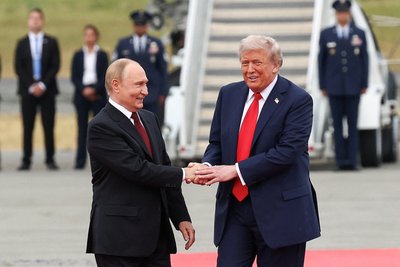
Putin and Trump met in Alaska. After their meeting, Trump said, “In two weeks you’ll see a decision about Ukraine.” But three weeks have passed and there's still nothing. What should we expect from Trump and U.S. policy?
If we keep holding our breath for those “two weeks,” we might suffocate. Those weeks will pass, and we are still holding our breath. We shouldn’t be doing that. If Trump wants to change his policy, nobody is stopping him. All the arguments are already on the table: Russia attacked Ukraine for no real reason, not for the first time, Russia will continue its attack. Putin has not changed his goals.
If Trump wants to shift, he can. But if he doesn’t, and we just keep waiting, it’s a very dangerous game. That’s why we need to act as if we are alone. Luckily for us, Europeans, Ukraine is showing how to do that—by believing in itself.
Trump also called on Europe to stop buying Russian oil and gas. Yet Europe collectively spent $33 billion on Russian gas. Do you think Europe can stop doing this? And how?
Clearly it is possible. Technically, there is no reason why you shouldn't be doing that. Yesterday I read a Hungarian minister's tweet that they signed an agreement with Shell to diversify [supplies]. I thought that maybe somebody broke into his account and tweeted something that I would not expect him to ever say. But it is obviously possible for Europe to do that.
Whether Europe will do that, I don't know. But just to look at it, it's shameful: Europe has spent more on Russian gas and oil than it has given to Ukraine. So in comparison, we are arming Russians better. History will judge Europe very harshly for this. Everybody will forget the nice words. In five years, nobody will look into, you know, "as long as it takes" or "Ukraine belongs in the European path". Everybody will look at the deeds.
So with this, I fully agree with President Trump. It should have happened long ago. Maybe with more U.S. pressure, Europe will finally move.
Speaking of money — Belgium has frozen Russian assets worth about €200 billion. But the government refuses to give these frozen assets to Ukraine, saying it would damage Belgium’s reputation as a financial center. Is that a real reason?
In a way, yes. Because if Belgium wants to be a financial center for blood money, then it is very important not to allow Ukrainians to use Russian frozen assets. Because in the eyes of other potential dictators and aggressors, they would stop trusting Belgium.
But again, in what context does Europe wants to find itself in? And it has been there. We are still remembering the stories of the Second World War, when so-called neutral countries were holding on to Nazi gold and art collections and whatnot. It’s a shameful period. And then you spend decades apologizing for what you did.
So it’s very difficult to convince the populations in Europe that we need to finance Ukraine. For many reasons, people are tired, they need money for other things, and so on. It’s understandable. I mean, we still should be doing that, I believe. But okay, it is difficult.
Now we have this Russian money. So what is better? To take Russian blood money, which would otherwise be used to build their army against innocent people, or give it to Ukraine, to our army? Instead of asking our children to pay the debts that we are accumulating for them.
What is your advice for Ukraine? How should we work with our partners and prove we are a good partner — for joint production with Belgium, Germany, Spain?
The so-called Danish model has been established as a very good example, though not many other countries follow it. But still, one of the major elements in conversations in the West, beyond geopolitics, is the internal situation in Ukraine. Obviously, I’m talking about corruption. This argument comes back again and again: “We could be investing more, but the situation is rather tough, we don’t trust the institutions,” and so on. It hasn’t gone away. And the longer the war continues, the more this argument resurfaces.
That’s why there was such a harsh reaction to the change of law about NABU. And it was very good that it was reverted. But it cannot be forgotten that these two battles — against the external enemy and the internal issues — have to be fought side by side. And Ukraine must give partners a very clear impression that it’s on the right track.
Anti-corruption reforms are also part of our EU integration process. Last week, Karol Nawrocki met with [the Lithuanian President] Gitanas Nausėda, who said Ukraine must join the EU no later than 2030. Do you think that is realistic? Because the Polish president has a different view on this issue.
One thing that has happened — and I’m really upset it doesn’t get enough attention in Europe — is the decision to decouple Moldova and Ukraine. Now Moldova will be opening new chapters and moving forward [in the EU integration process], even though there’s no merit-based reason for it. It’s clearly a political decision. So Ukraine is being left behind, even though it’s carrying out reforms.
I think it’s a very dangerous decision, because it demotivates the country and demoralizes the people who are working in this sphere. It’s really bad. And it’s very unfortunate that even my country and my president, who had the ability to stop this, did not raise a voice. They could have refused to allow the decoupling, called Hungary’s bluff, and kept both countries together to move forward at the same speed.
One thing is to say “yes, we would like to do that.” But another thing is when your ambassador is sitting at the table — you instruct him or her to vote against something that is not good for Ukraine.
And my last question: what should we do about this? How can we in Ukraine change it?
Some things are beyond your control. Europe is a complex mechanism, with a lot of internal political issues. And honestly, it's not living its best days right now.
So continue with reforms as if you are on the path. Because the reforms are not for Brussels — they are for you. And just don’t stop. Whatever happens, I’m sure that Ukraine will emerge stronger and ready for accession when the war is over.