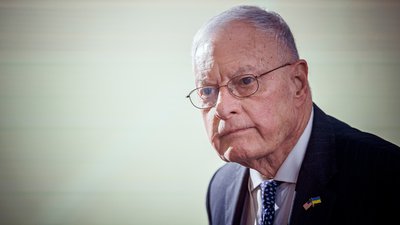
Keith Kellogg is the former U.S. Presidential Special Envoy for Ukraine under Donald Trump. He is a retired U.S. Army general and currently serves as co-chair of the Center for American Security at the America First Policy Institute.
Suspilne spoke with General Kellogg following contacts between the Ukrainian and Russian sides in Abu Dhabi in November.
What should realistic expectations for these contacts be? How will the meeting in China between Putin, Trump, and Xi conclude? And what is the real significance of the humanitarian mission in Oleshky? General Keith Kellogg answers these and other questions in the project Removska Interview. Watch the video version of the conversation here.
General, thank you for joining us. We are having this conversation against the backdrop of renewed attempts by Ukraine and Russia to reach an agreement, mediated by the United States. Talks in Abu Dhabi have just taken place.
What could be the realistic outcomes of such negotiations right now?
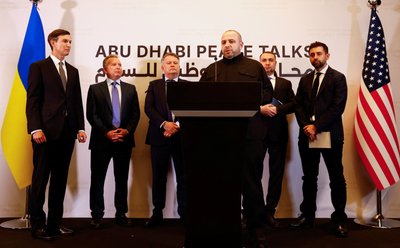
Here's the reason I'm a little bit optimistic. It is because finally, instead of having a businessman from the Russian side (Kirill Dmitriev), be there as the lead, you've got Medinsky, who is a hardliner, and he has written some things that are questionable. But they brought the whole team, which means you at least start with people who are really vested in getting to a solution, at least hopefully.
The same as on the Ukrainian side when you brought Umerov, Budanov and Arakhamia in, you brought them in there.
And I think now, while they're both hardliners, at least now you have the right people doing the discussion. I don't think you're gonna come to an agreement right away, but at least you have people talking about it.
Maybe you can use Oleshky as a model. Or to get to a point where you can get to a ceasefire gradually along the border.
You mentioned the participants of the delegations. But also, as far as I understood, what both Western media and Ukrainian media are pointing out – is that Russians are trying to shift the focus of these negotiations from the Russian-Ukrainian war to some kind of the 'new architecture of security' in Europe.
Don't you think that Russians may really try to shift the attention from the war, which they maybe don't want to end, to some other, more abstract topic?
Well, of course, they do, because that's typically what the Russians try to do. And I think when you've got Kallas and part of the EU, and you got Grynkewich, who's the senior military commander, and you have what's now called the E4, which is the, really the national security advisors from Germany, from the UK, from France, and now they've included Italy as well — they are gonna protect their own interests.
I think [the Russians are] really kind of throwing something against the wall, that are gonna stick. But I think the Europeans are pretty hard about what they want.
I kind of understand that the Russians would try to do that. It's up to the Ukrainian delegation and the European delegation to say, «No, we are not going there.»
Do you have this feeling that the US delegation recognizes the right of the European participant to be present at this type of negotiations?
I think they are supposed to be there because of the support they gave in Ukraine, and the fact that it's in their – as we call it in America – it's their backyard.
I think the Russians don't want them there because they believe they can somehow create some type of deal with the United States, which will force Ukraine to make a decision.
You know, I think the Ukrainians are correct that they're not gonna give up land voluntarily. I think that's the proper approach. And I think that was relayed quite well to the Russians. They may not like it, but that's what they need to hear. And understand that, you know, the approach is gonna change a little bit, but they're gonna have to change their approach as well.
Considering all of the developments, what kind of deal do you think, Vladimir Putin really wants?
What Putin wants is clearly to take everything that he's [planned]. He probably wanted to take all of Ukraine. Then he wanted to take the four oblasts, discounting Crimea right now. That's what he wants.
But the fact is, what kind of deal can you say to the Ukrainians, to the Russians? How do you get to a ceasefire in place? And maybe you can use the model that the First Lady of the United States recently did with Oleshky, in your negotiations with the Russians as well on humanitarian grounds to start to establish a ceasefire all along like a demilitarized zone.
That's maybe kind of where you want to go to do something a little bit different, which it preserves everything you've got right now and gets to the cessation of hostilities where you stop the killing on both sides.
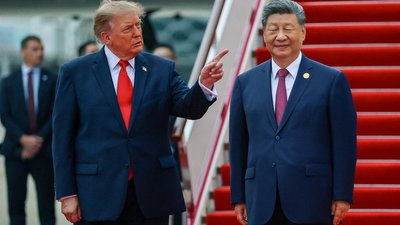
There is a possibility that Putin, US President Trump, and Chinese leader Xi will meet in November in China. How do you view the prospect of such meeting? Especially considering the fact that Putin gets this unique opportunity to meet all the leaders he is so closely watching at all these years?
I think when he goes to the G20, as long as he understands the positions, I think what he may want to say and what he can do really won't matter very much.
So I think he's gonna go there, maybe say a few things that are nice. But as long as everybody stays kind of united in their efforts, there's not much for him to discuss other than, «Well, why don't you have some type of agreement?»
That's the reason I'm saying: before he goes there, maybe float a different type of proposal. What really works, and what's not gonna work? I mean, if you continually address the same solutions that you've got right now that have not worked, well, that's kind of foolish. And if that doesn't work, what's a new solution?
And I think maybe that's what it'll bring after Jared Kushner and Steve Witkoff meet with President Zelensky. They met with President Putin. They were at Abu Dhabi.
So let's just see how it works and what they brought back after they meet President Zelensky in Dublin, Ireland, and then we'll kind of know better.
How do you predict, will the American delegation raise the question of the Russian-Ukrainian war at this meeting in China? Because Putin, I suppose, would prefer not to talk about his war against Ukraine there.
You're probably right. He's probably not willing to talk about it. Because he realizes Ukraine's not gonna give in to what his demands are. And I believe that Witkoff and Kushner will return to the President of the United States and say, «This is what they learned in Abu Dhabi and in Moscow and in Dublin, Ireland,» and then let him go forward and basically say, «This is the ground truth of what you have.»
Let's just see what comes out of the final talks. It'll probably break in the next few days what actually happened. And then you can say, «Okay, this is where you want to go with the next steps,» and maybe come down with a different proposal.
And what I have noticed with President Putin and President Trump – if you present Putin another example of something to be done, then it really makes him go back to the drawing board. And the advantage of having Xi there is… President Xi of China has probably been underwriting most of what Russia is doing. Because Russia is actually the junior partner, not the senior partner in that relationship. So I think it's important that if Xi understands, then maybe he can put pressure on Putin, maybe in private counsel, maybe you can get to some type of, hopefully, resolution in the near term.
We are recording the interview on the 12th of November, and today reports have emerged, that Ukraine is experiencing once again a slowdown in Starlink operations on the front. In your opinion, could this be pressure on Ukraine as part of the negotiation process?
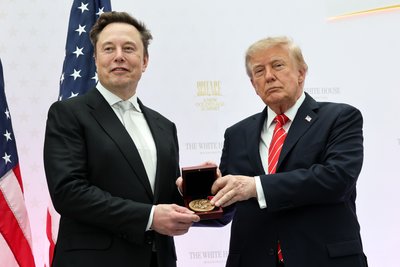
I think anything you can see like that is pressure. But people need to understand that Starlink is a private company owned by Elon Musk, a private corporation. It's not government.
What you say is that Starlink's slowing down, or the Pentagon version is slowing down? They insisted that the last time that was said wasn't true, that it didn't slow down. Now, that's up to Elon Musk in the private corporation, and then the Pentagon one. The Pentagon one didn't slow down.
If you use the public version of Starlink, it's gonna be up to Musk, how Musk believes. Because we can only put so much pressure on a private corporation, and he owns Starlink, we don't.
Could it be a private initiative of Elon Musk to make US President Trump feel better? The last time when Ukraine mentioned that it experiences this slowdown in Starlink operation, it was right after the US President Trump blamed Ukraine for this global diesel shortage – due to Ukraine's strikes on Russian oil refineries.
By the way, he's revised that. He's kind of said, «Okay, it's really the Iranian war that's caused the slowdown.» And those Russian's tankers filled with oil, they're not coming to US ports because the ports in the United States are refusing to unload them. So now the Russian tankers are looking for a safe harbor to go to.
What you said, though, is accurate. Now, I don't know the thinking that Elon Musk has or the slowdown of [the Starlink]. I would say that, I think as every day goes by, let's find out exactly what the real story is. There's an old army adage, in the United States Army, that the first reports are always wrong. So let's just see what happens on the second and third reporting right now.
We don't have much time, but I would really like to ask you about the Oleshky humanitarian mission. How do you assess this event, both as a general and also as a person who participated in peace efforts?
What I like about Oleshky, and the First Lady was involved, the United States, and the Russians, and the Ukrainian delegation, — it's a way of doing things differently.
If you keep doing the same thing over, and over, and over again, and the answer is continually no, no, no — well, maybe we ought to look at it differently. And maybe Oleshky is a model. I'm not saying it's 'the' model, but it's 'a' model to get through humanitarian relief, to get to a ceasefire, to cut down on the killing. I think it's worth looking at. I'm not saying it is the solution, but it's at least it's a different solution going forward.
And when we had an opportunity to talk to Ukrainian delegation afterwards. And I think that, okay, well, maybe we can approach this differently, and especially as winter's coming on. To see if there is a different way to operate and a different way to do it.
So I'm a perennial optimist, and I'd like to think maybe there's a way we could do this differently. And I'm not saying I have the solution, but let's look at it and see if it works.
But why did Russia agree to such a step? There was a brief ceasefire to evacuate Ukrainians from the combat zone, in fact. But it seems very unlikely that Russia is concerned about people very much.
Well, yeah. I think your latter point is correct.
But I think they looked at it as «Оkay, this is a different approach». It was a humanitarian approach. a balanced one. As I said, they looked at it differently, we looked at it differently, the Ukrainians looked at it differently. So I think maybe they said, «Okay, that's the model maybe we want to look at.»
You kind of want to get the current people who are negotiating out of it. You want to get the generals out of it, and maybe you can look at this on humanitarian grounds.
Let's see if maybe they can expand on that.
The US midterm elections took place recently. In your view, could there be any kind of a significant shift in US-Ukraine relations after them?
Well, I think first of all, what Ukraine needs to understand is that 66% of the American people support what's happening in Ukraine. That's a good number. Because there are still around 30% of Americans probably believe that the sun will rise on the West Coast, not the East Coast. So I don't worry, you're not gonna get 100%.
Only 3% believe the Russians are in the right position.
I think that's a good thing to have, the number to have. And I think the new Democratic Congress will be more supportive, based on what's happening in Ukraine.
Now, that Congress doesn't come in till January. So you've got the same old guard currently.
Is the US President Trump listening to the people, their attitude towards the situation?
Well, that's a good question. I don't know what the answer is. I'll have to see how the public pronouncements work, and what happens when Jared Kushner and Steve Witkoff come back.